Fix Your Half

The embrace has two halves and one connection. You can only ever repair one of them, and it is not the one you keep looking at.
Every milonga has a bench where tandas get reviewed. The music stops, two people walk back to their seats, and the post-tanda analysis begins.
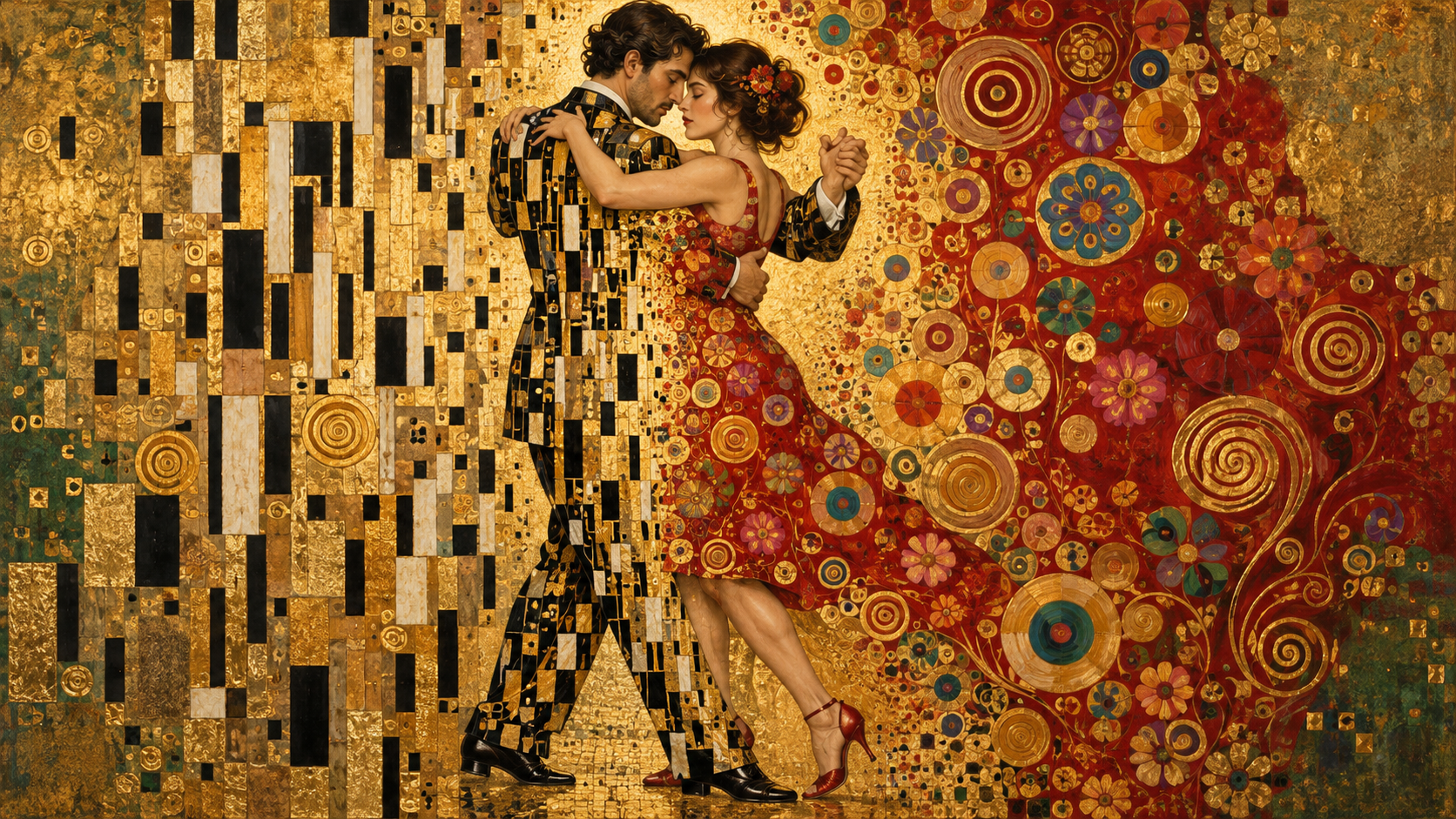
Visual by Anita Flejter, created with generative AI tools. Inspired by the atmosphere of Argentine tango and the paintings of Gustav Klimt.
Here is the leader’s review, more or less word for word, as I have heard it many times:
“She treats me like a dance pole. She just dances around me. When I try to lead, she doesn’t feel the direction clearly. Her steps are too small, or in the wrong direction. She expects me to push her into every step.”
And here is the follower’s review, from the other end of the room, often about the same tanda:
“He just moves all by himself without telling me anything. He doesn’t even hold the embrace, so I can feel something. He is like a ghost. It takes so much effort to guess what he is trying to do.”
Both of them mean it. Both of them have evidence. And both of them have just done something every tango dancer does, including the ones who teach: they reviewed the tanda by looking only at the half they could not control.
Read the two complaints again, side by side. She says he is a ghost. He says she needs to be pushed. That is not two bad dancers. That is one missing connection, described from both ends.

Visual by Anita Flejter, created with generative AI tools. Inspired by the atmosphere of Argentine tango and the paintings of Gustav Klimt.
Why it is always the other half
There is a well-documented habit of the human mind called the self-serving bias: we credit our successes to ourselves and our failures to everything else. The student with an A studied hard. The student with a C had an unfair test. (Simply Psychology)
Tango is a perfect machine for this bias. A good tanda feels like my musicality, my clarity, my beautiful ochos. A bad tanda feels like the partner.
And the embrace makes it worse, because partner dance is one of the very few places where you cannot see your own mistakes. In a solo dance, you watch yourself in the mirror. In tango, your mistakes leave your body, travel through your partner’s, and come back to you looking like their mistakes. You led it unclearly, she stepped somewhere unexpected, and what you saw was her stepping somewhere unexpected.

Visual by Anita Flejter, created with generative AI tools. Inspired by the atmosphere of Argentine tango and the paintings of Gustav Klimt.
So the first step is simply knowing this: when a tanda goes wrong, your nervous system will hand you a culprit, and it will almost always be the other person. Thank it politely and investigate anyway.
The leader’s half: arms are part of the body
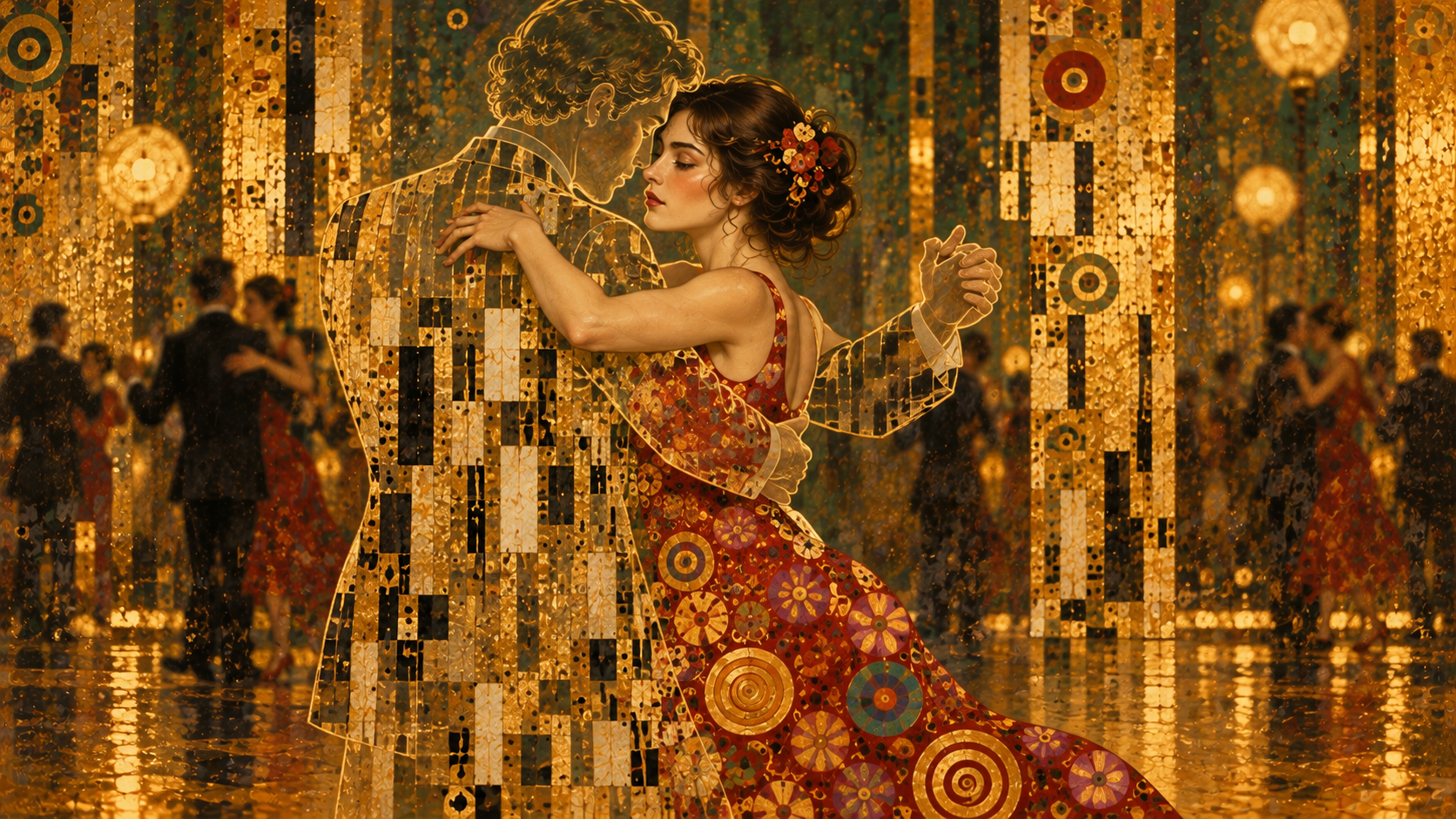
Visual by Anita Flejter, created with generative AI tools. Inspired by the atmosphere of Argentine tango and the paintings of Gustav Klimt.
Every leader has heard the correction “don’t lead with your arms.” It is good advice, and it has a side effect almost nobody talks about.
Many leaders take it so seriously that they stop using their arms at all. They are so afraid of being told they are arm-leading that the arms go quiet, the embrace goes loose, and the body moves on its own inside an empty frame. That is the ghost from the bench. The follower is not imagining it. There really is nothing there for her to feel.
So let me put it more precisely. The problem was never the arms. Arms are part of the body. The problem is arms that are disconnected from the body, and they can be disconnected in two opposite ways.
Arms working alone. The movement starts in the hands and arms, and the torso follows a moment later, or not at all. The follower receives a push before she receives a direction. Worse, the signals can contradict each other: if the arms say “go there” and the chest says “stay here,” she has to pick one, and she will pick whichever is clearer to her body. From your side it looks like she went the wrong way. From her side, she followed exactly what she felt. And an embrace driven by the arms gets tight, heavy and tiring, so she stops feeling invited and starts feeling steered.
Arms switched off. The opposite failure. The arms hang politely around the follower but carry nothing. The chest moves, but the information has nowhere to travel, because the frame that should carry it to her back and her hand has gone soft. She is left guessing, and guessing is exhausting. This is the ghost.
Both are the same mistake seen from two ends: the arms are not part of the movement.
The fix is not “use your arms less” and it is not “use your arms more.” It is to make the arms connected again. The movement starts in your center, your chest and your body mass, and the arms belong to that movement, connected through your back, holding the follower so she can feel where the body is going. They do not take over, and they do not disappear.
A simple starting point: for now, think of the embrace as one piece. When your chest turns, your arms turn with it. When you stop, the whole embrace stops with you. If that works, your arms are part of your body again, and the ghost is gone.
I should be honest that this is a starting point, not the whole truth. In real tango the arms and the body are not always one block. Sometimes there is a slight delay between them. Sometimes they move together. And because the two partners do not always move as mirror images, a leader often has to send the follower one way while their own body goes another way, or a slightly different way. That decoupling, the art of moving the torso, arms and legs separately while keeping the connection, is where tango gets truly subtle, and no two movements solve it in exactly the same way. It deserves its own posts, and it will get them. But it is built on top of a connected embrace, not instead of one. First the arms come back to the body. Then you learn when to let them go their own way.
(What the hands themselves are for is a big enough topic for its own post too. It is coming next.)
The follower’s half: “I don’t feel it”
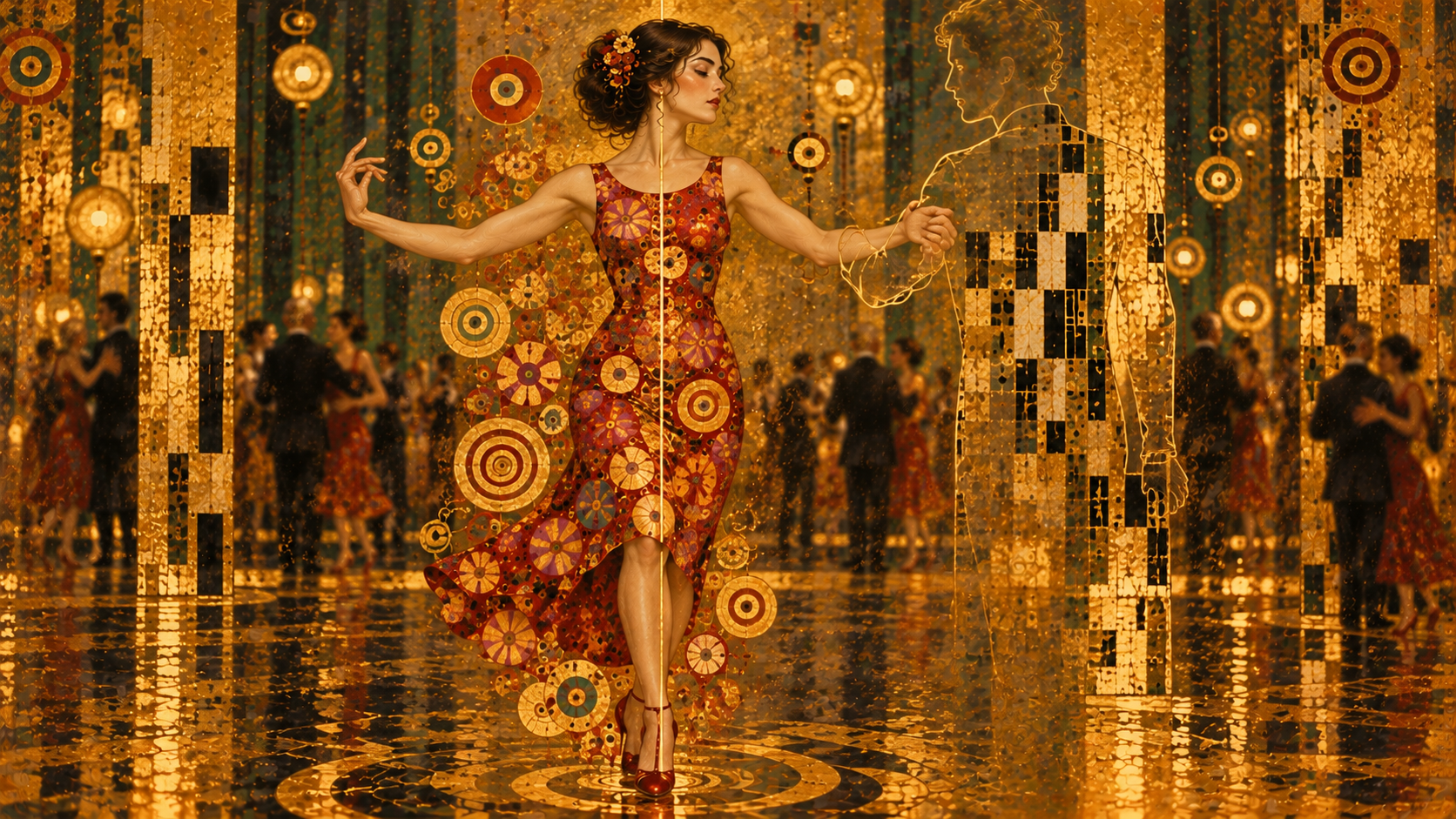
Visual by Anita Flejter, created with generative AI tools. Inspired by the atmosphere of Argentine tango and the paintings of Gustav Klimt.
Sometimes this is completely true. Some leads are unclear, and no follower can receive a signal that was never sent.
But often “I don’t feel it” means something else: there was nothing on the follower’s side for the signal to land on.
No axis. A follower who is leaning on the leader, or hanging slightly back, is already moving before anything is led. A clear lead cannot change the direction of a body that is already falling.
No tone. Think of the follower’s frame as an antenna. If the arms and back are soft like cooked spaghetti, the signal disappears into them. If they are rigid like a plank, the signal bounces off. A good frame is alive in between: present, slightly toned, ready to transmit movement from the chest to the whole body.
Guessing. The most common one of all. The follower hears the music, recognizes a moment where an ocho usually happens, and dances the ocho. The leader meant a pause. The follower concludes the leader was unclear. The leader concludes she does not listen. In fact, she was dancing the tanda she expected instead of the one in front of her.
And notice the two extremes the leader on the bench described. The follower who “dances around me like a pole” is decorating instead of receiving. The follower who “expects me to push her into every step” is waiting so completely that she brings no energy of her own. One is too independent, the other too passive, and both leave the leader with nothing to talk to.
The fix is not passivity. Following is an active skill: being on your own axis, keeping your embrace alive, and waiting until something is actually led, even when the music tempts you to go first.
What science says about the signal
Visual by Anita Flejter, created with generative AI tools. Inspired by the atmosphere of Argentine tango and the paintings of Gustav Klimt.
It is tempting to think the answer is about strength: lead harder, or lead softer. Research suggests the answer is about clarity.
In a 2017 study at Emory University and Georgia Tech, researchers asked pairs of dancers to do a simple stepping task blindfolded and wearing earphones. The only way to communicate was through handles held between them. Leaders knew the step pattern, followers did not. Each pair was two experienced partner dancers (at least ten years of experience), two complete novices, or one of each. (Sawers et al., 2017)
Two findings matter for the bench.
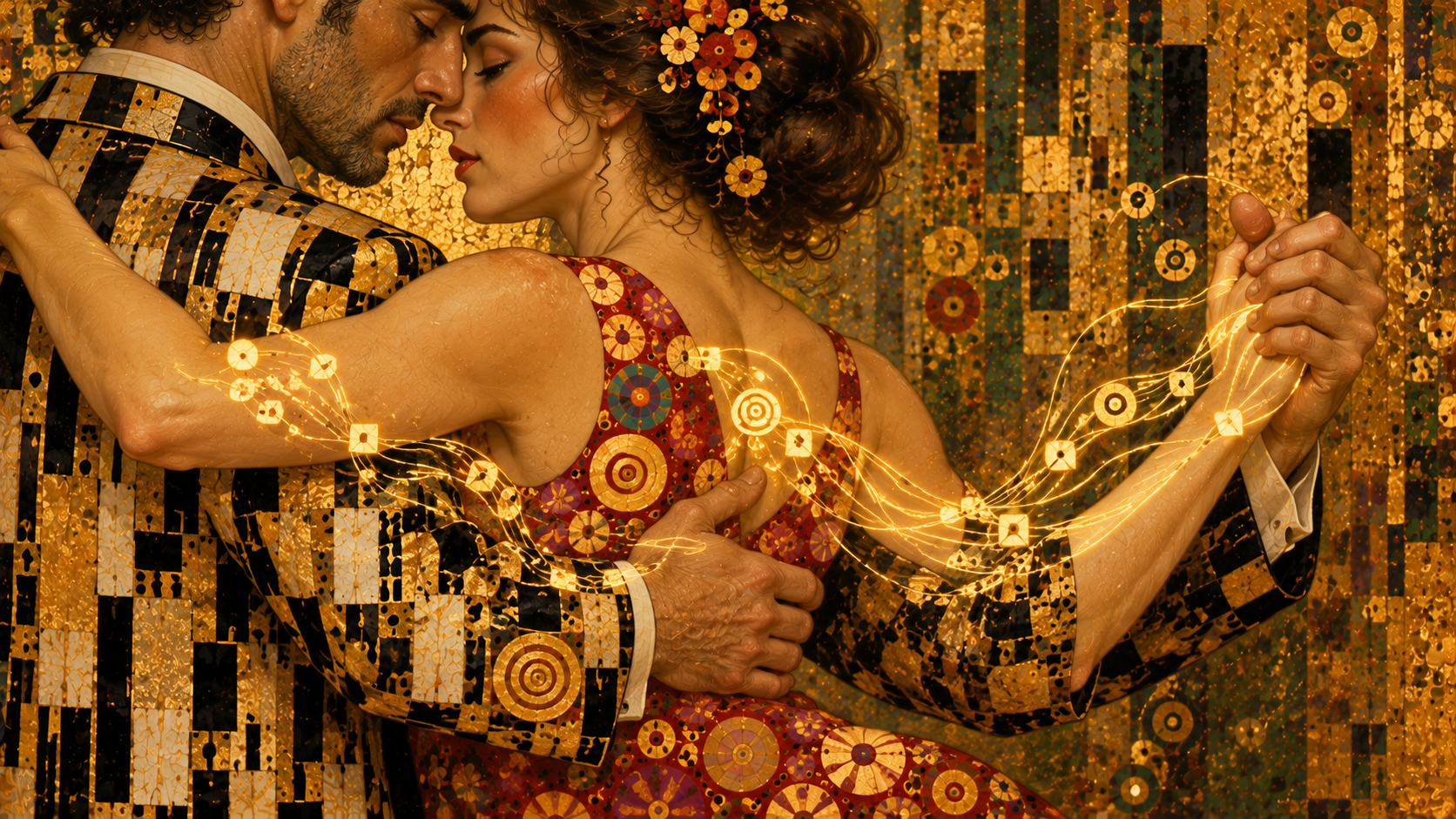
First, the forces that carried the information were small: overall roughly in the range of what you use to brush your hair. Leading is not moving someone. It is telling them.
Second, the expert pairs did not whisper. They actually used somewhat larger and more structured forces than the novice pairs, with the force changing clearly in each phase of the step. And only the expert pairs got better at moving together as the trials went on. In other words, experience did not make the signal softer. It made it clearer and better timed, on both sides of the connection.
That is the whole post in one experiment. A good tanda is not one strong dancer carrying a weak one. It is two people who have each learned their half of a conversation.
Three questions for your half
Next time a tanda goes wrong, before you review your partner, ask yourself three questions about your own half.
If you lead: - Did my arms move with my body, neither leading alone nor switched off? - Did I wait for her to arrive before I led the next step? - Was I leading the music, or my next figure?
If you follow: - Was I on my own axis, or leaning on him? - Was my embrace alive, not spaghetti and not a plank? - Did I wait for the lead, or did I dance what I expected?
Either way: - Was I listening to my partner, or only to myself?
You will not answer yes to all of them every time. Nobody does. But you will notice something interesting: the tandas you blamed on your partner start to look different.
Where to fix it (not on the floor)
Visual by Anita Flejter, created with generative AI tools. Inspired by the atmosphere of Argentine tango and the paintings of Gustav Klimt.
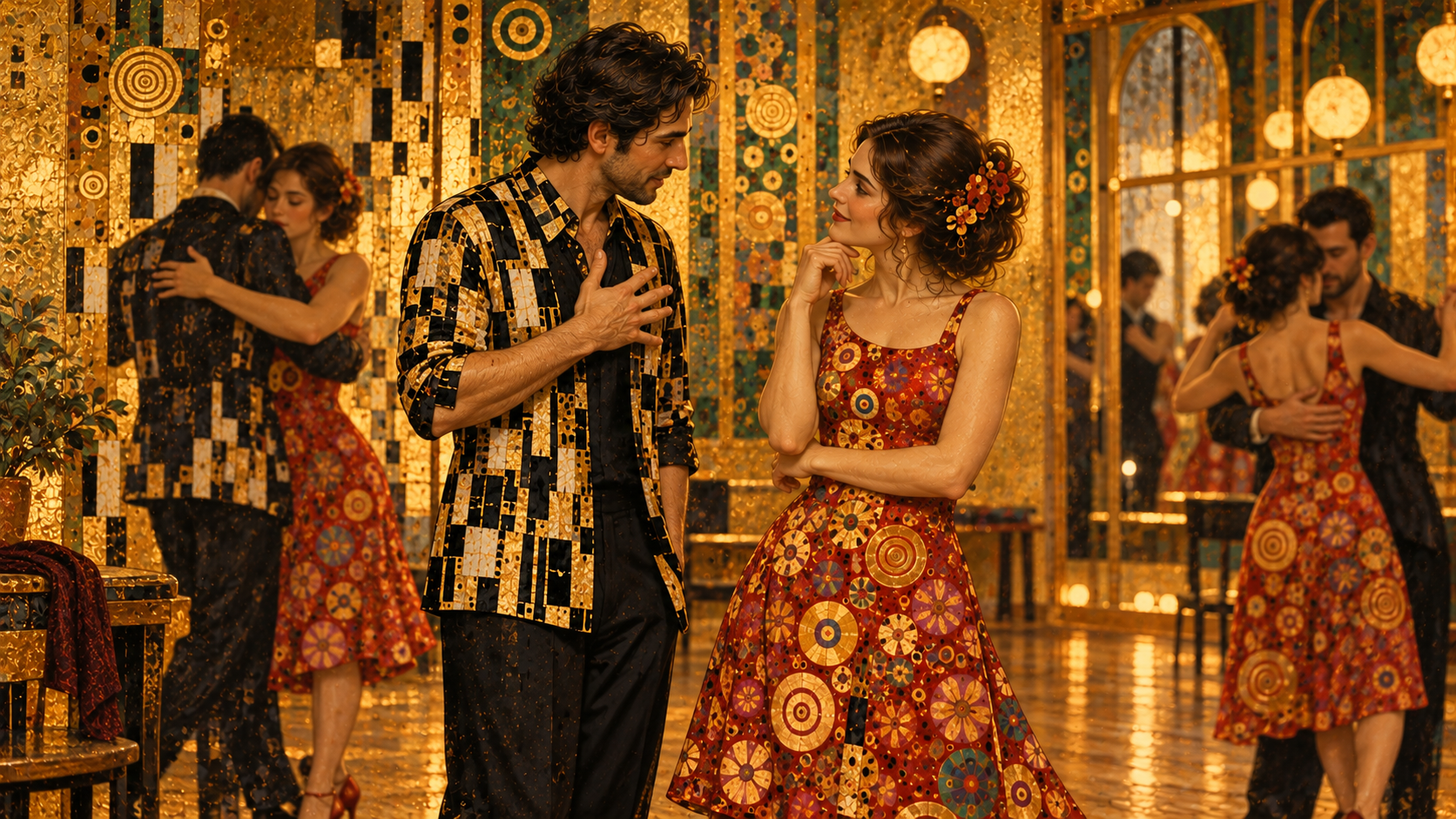
One rule, because it saves friendships: do not fix your partner during the tanda. Teaching on the milonga floor is one of the oldest unwritten codes of tango for a reason. Nobody has ever said “thank you for the correction” between two songs and meant it.
Fix your half at a practica, where questions are welcome. The best one you can ask is not “what did you do wrong?” but “what did you feel when I did that?” The answer will tell you more about your half than any mirror.
And fix it in class, where a teacher can see both halves at once, which neither dancer in the embrace ever can.
Two halves, one connection
Visual by Anita Flejter, created with generative AI tools. Inspired by the atmosphere of Argentine tango and the paintings of Gustav Klimt.
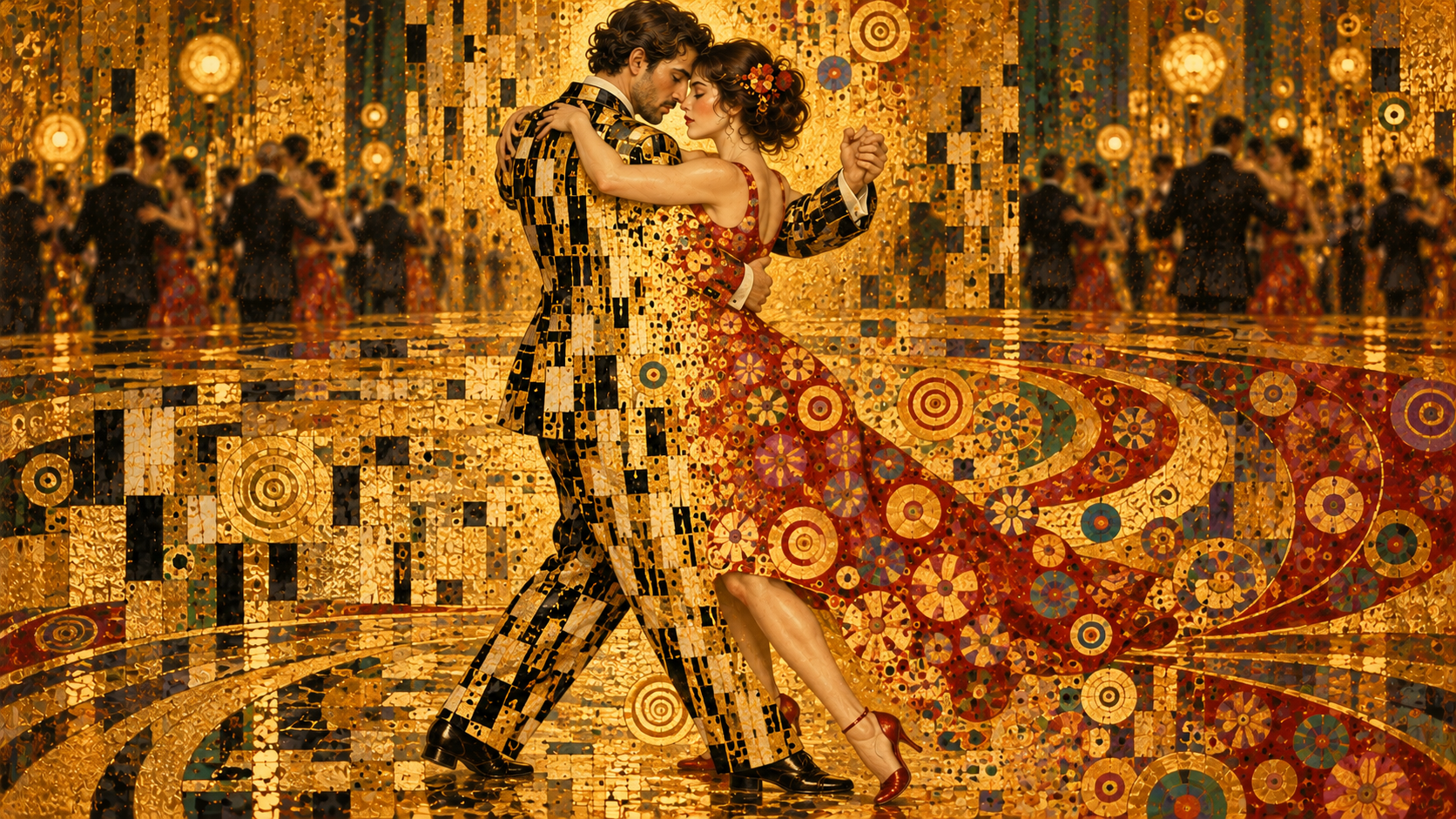
Here is the quiet good news hiding in all this. If every dancer on the floor took care of their own half, there would be nothing left to blame. The leader moves from the body, with arms that carry the movement instead of starting it or abandoning it. The follower stands on her axis and waits. The signal is clear and it lands somewhere ready to receive it.
What is left after that is not a technical problem. It is just the music, and two people listening to it together.
You cannot fix your partner. But you can fix your half. And it turns out that is more than half the dance.
Sources
Self-serving bias: Simply Psychology
Sawers, A., Bhattacharjee, T., McKay, J. L., Hackney, M. E., Kemp, C. C. and Ting, L. H. (2017). Small forces that differ with prior motor experience can communicate movement goals during human-human physical interaction. Journal of NeuroEngineering and Rehabilitation 14:8. PMC