Tango as a Second Language: Why Your Brain Hurts and That's Good

If your first few months of tango feel like drowning in a conversation where everyone else is fluent, you are not broken. You are exactly where you should be.
Learning Argentine tango is structurally identical to learning a second language. Not metaphorically - actually. Your brain is doing the same work: decoding unfamiliar syntax, struggling to produce output in real time, and occasionally freezing when too many variables hit at once.
The cognitive load is nearly identical. In both cases you are asking your brain to process multiple streams of information simultaneously while producing a coherent response under social pressure. Understanding that changes everything. It reframes your frustration from "I am bad at this" to "My brain is doing exactly what brains do when they learn complex embodied languages."
The Silent Period
In language acquisition, there's a concept called the silent period. It's the months (sometimes a year) where a learner understands far more than they can say. They listen. They absorb. They feel stupid. Then, one day, sentences start forming without conscious effort.
Tango has the same silent period. You attend classes. You watch the floor. You absorb the music. You begin to recognize the difference between a tango and a milonga. You can spot a good dancer from a mediocre one. You know, intellectually, what a cross is and how it differs from an ocho. And when someone asks you to dance, your brain short-circuits. Your body refuses to execute what your mind understands. That's not failure. That's your nervous system building a database before it trusts itself to produce.
The silent period is uncomfortable because it looks like incompetence from the outside. You know what you want to do. You cannot do it. In language, this is well documented and accepted. Teachers know not to force output too early.
In dance, there is less patience. Students expect linear progress. Teachers feel pressure to show concrete results. The result is often premature performance: people pushed onto the dance floor before their bodies have finished absorbing the grammar, which creates bad habits that take years to undo.
The problem is that most dance instruction treats tango like a vocabulary test: here is a step, now use it. But tango is not a list of words to memorize. It is a living language, and learning it requires the same thing learning any language does: structure, practice, and real conversation.
At Ultimate Tango, we teach progressively. We break the dance down element by element and spend time on each one so you understand not just what to do, but how it works. That structure matters. It is your grammar, your foundation.
But no one becomes fluent through drills alone. At some point, you have to step into the conversation. You need to fail, adjust, and gradually let go of translation. You need both the classroom and the milonga, the rules and the risk, the scales and the song.
This is where language acquisition research becomes useful. Stephen Krashen's work on comprehensible input shows that we acquire language by understanding messages slightly above our current level, but research also confirms that input alone is not enough. As Clozemaster summarizes the current consensus:
"Research strongly supports the importance of comprehensible input... Current consensus recognizes the value of comprehensible input, but also acknowledges the limitations of the Input Hypothesis. You need large amounts of understandable input, and you'll usually progress faster when you combine that input with output practice and some strategic study."
(https://www.clozemaster.com/blog/input-hypothesis-language-learning-explained/)
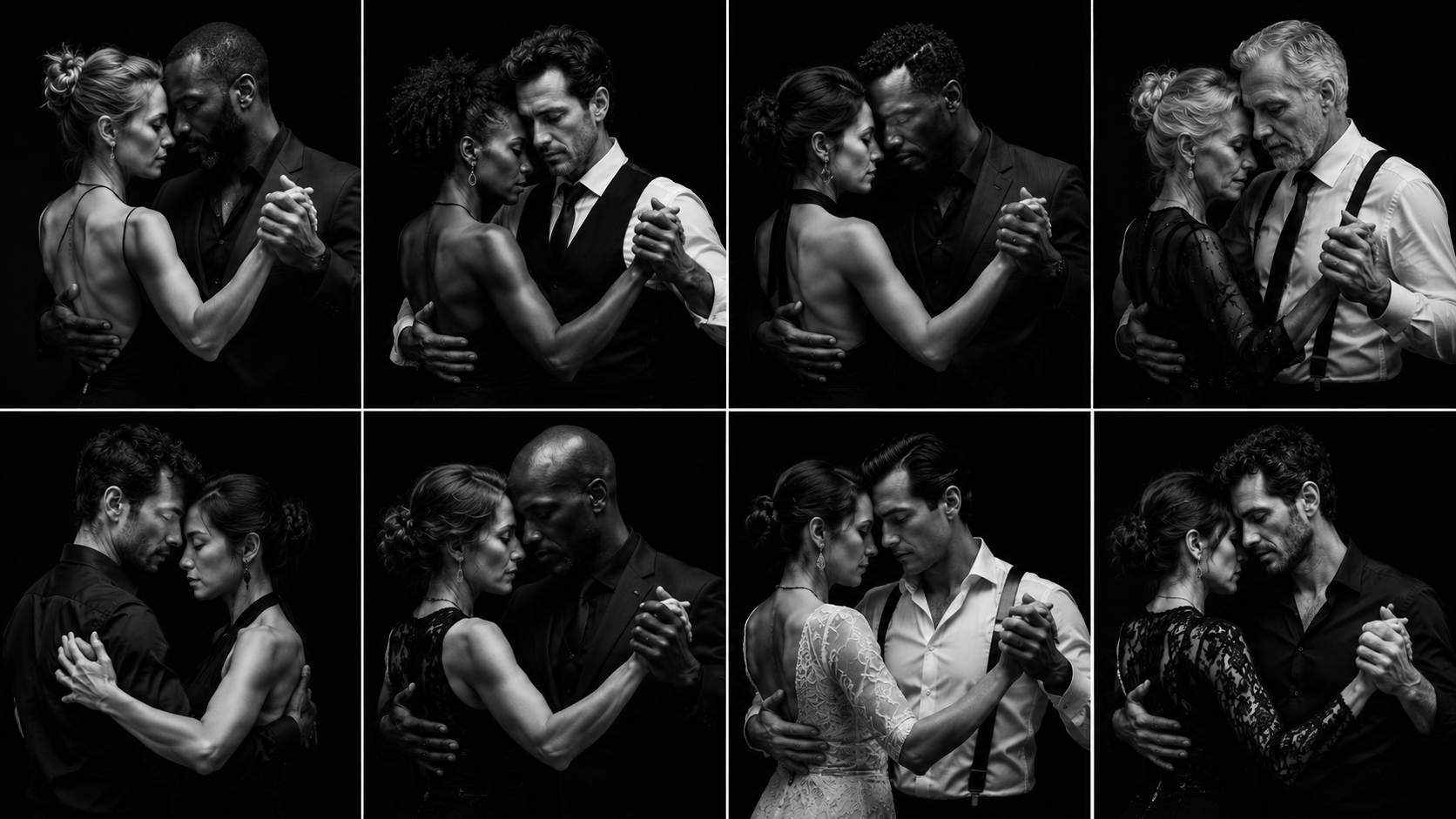
Visual created by Anita Flejter with the use of generative AI tools, inspired by the atmosphere and emotion of Argentine tango.
Applied to tango, this means four things happening at once. Think of them as the four legs of a table. Remove any one and the whole structure wobbles.
Continue with your drills. Repetition builds the muscle memory that lets you stop thinking about your feet. A pianist does scales. A boxer does footwork drills. A language learner practices conjugations. The drills are not the goal. They are the foundation that makes improvisation possible.
Keep learning new elements. Each new step is a new word in your vocabulary. But learn it as grammar, not as a trophy. Understand why it works mechanically, where it fits musically, and what doors it opens for connection.
Seek immersion. Get to the milonga, fail, adjust, listen to the music in your body instead of in your head. The milonga is not a test. It is a conversation class. You will say things wrong. You will feel exposed. That exposure is the input your brain needs.
Look for the hooks. Try to see how elements connect, where one movement opens a door to another, how the simple pieces you already know can be rearranged into something you have never done before. This is the creative grammar of tango. The cross you learned in month one becomes the entry point to a hundred different sequences once you understand its properties.
The Memory Trap
The irony is that even advanced dancers sometimes treat tango as a memory test. They collect complex sequences like trophies and repeat them as proof of what they know. But the language never stops developing. Memorizing harder sequences does not make you a better speaker.
What matters is understanding how the elements are built, so you can create in the moment instead of reciting from a script.
This is not just an opinion. Research on dance improvisation confirms that true improvisational skill requires embodied knowledge developed through sustained practice, not the memorization of set phrases.
As one study notes:
"Improvisational interaction in dance requires a substantial foundation of embodied knowledge that can only be developed through exhaustive and sustained embodied learning." (https://pmc.ncbi.nlm.nih.gov/articles/PMC13021783/)
The simple elements never go away. They are the verbs and connectors of your dance, the things you return to again and again to make meaning out of movement.
A researcher at Queen's University Belfast documented this exact tension in interviews with tango dancers. One amateur tanguero named Pablo described his own plateau with painful honesty:
"I don't know if I improvise yet. I don't have enough tools to improvise... I end up using the steps I've been taught as phrases, as sequences. Right now my creativity limits to knowing if [a sequence] fits or not [within the musical phrase]." (https://pure.qub.ac.uk/files/221840844/The_Movement_of_Argentine_Tango.pdf)
Pablo was in year two. He could see the problem: he was speaking in memorized sentences instead of generating his own. He had vocabulary. He lacked grammar. He could recite but not converse. The way out is not more vocabulary. It is understanding the grammar deeply enough to build your own sentences.
This is where many dancers plateau indefinitely. They confuse accumulation with fluency. They collect steps the way some people collect stamps: for display, not for use. The result is dancing that looks impressive in fragments but never achieves the continuous flow of a real conversation.
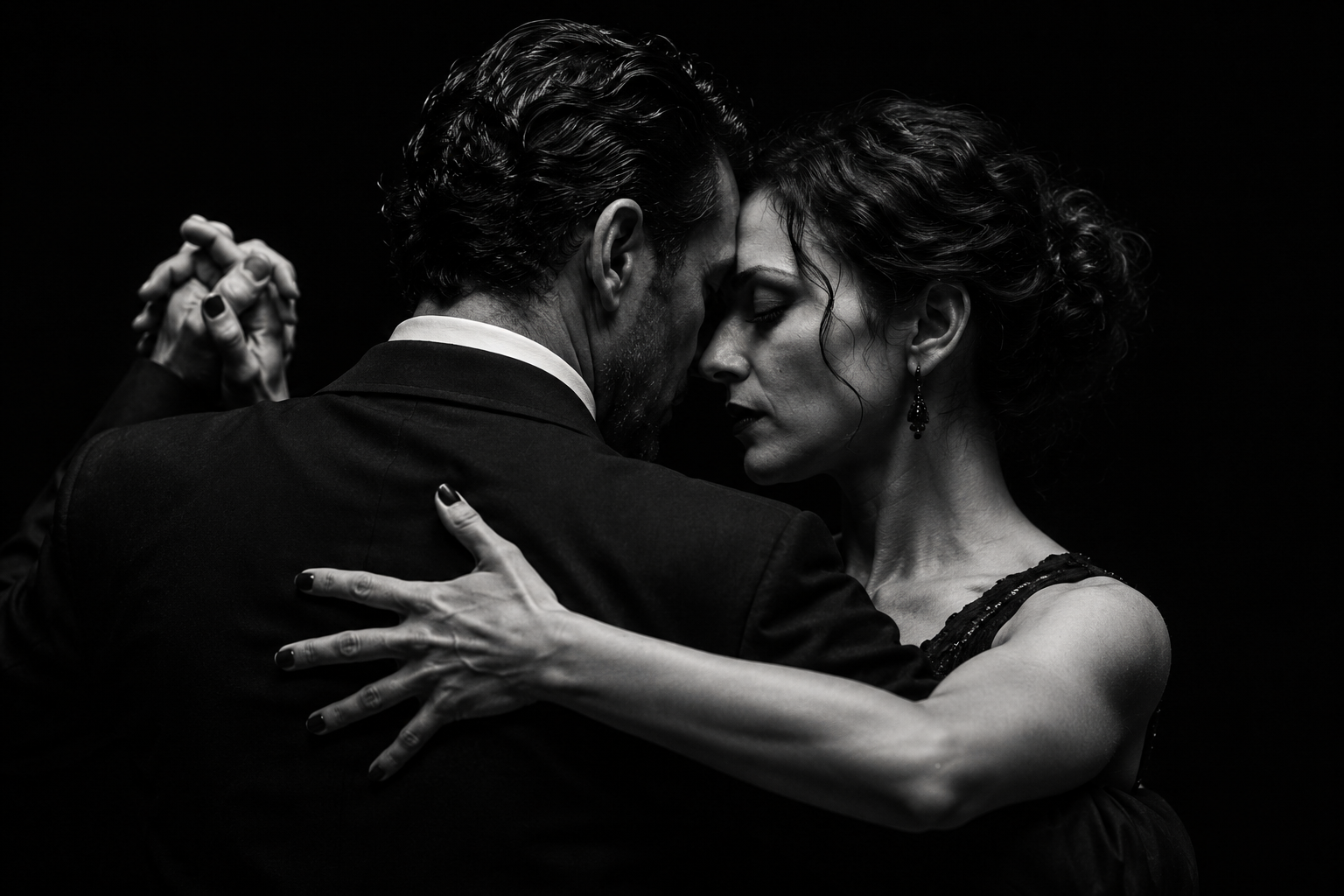
Visual created by Anita Flejter with the use of generative AI tools, inspired by the atmosphere and emotion of Argentine tango.
The Switch
There is a specific moment in both language and tango when the switch flips. You stop thinking about grammar and start thinking in the language.
In tango, you stop counting and start responding. The embrace becomes information. The music becomes instruction. Your body knows things your mind hasn't caught up to yet.
That moment is not earned through perfection. It is earned through volume. The more conversations you have - awkward, halting, partially successful - the faster your brain recognizes patterns and automates responses. This is why immersion works. Not because immersion is magic, but because immersion provides the volume of input and interaction that your brain needs to automate the basics so the conscious mind can attend to higher-order tasks.
Before the switch, dancing feels like translation. You hear the music, you think about what step fits, you try to execute it while managing balance and connection and spatial awareness and the emotional reality of standing three inches from a stranger. After the switch, the music goes in and movement comes out. You are no longer managing variables. You are inside the system.
This is why experienced dancers seem to have more freedom, not less. Their constraint is fluency, not vocabulary. A fluent speaker can say anything with a small vocabulary. A fluent dancer can dance an entire tanda with six steps, because the steps are no longer the point. The point is the conversation. The point is what happens between the steps.
When you watch a dancer who has made the switch, you are not watching someone who knows more steps than you. You are watching someone whose brain has automated the fundamentals. Their working memory is free. They can listen. They can respond. They can play. You could teach them a new step in thirty seconds and they would integrate it immediately, not because they are gifted, but because their foundation is solid enough to absorb new information without collapsing.
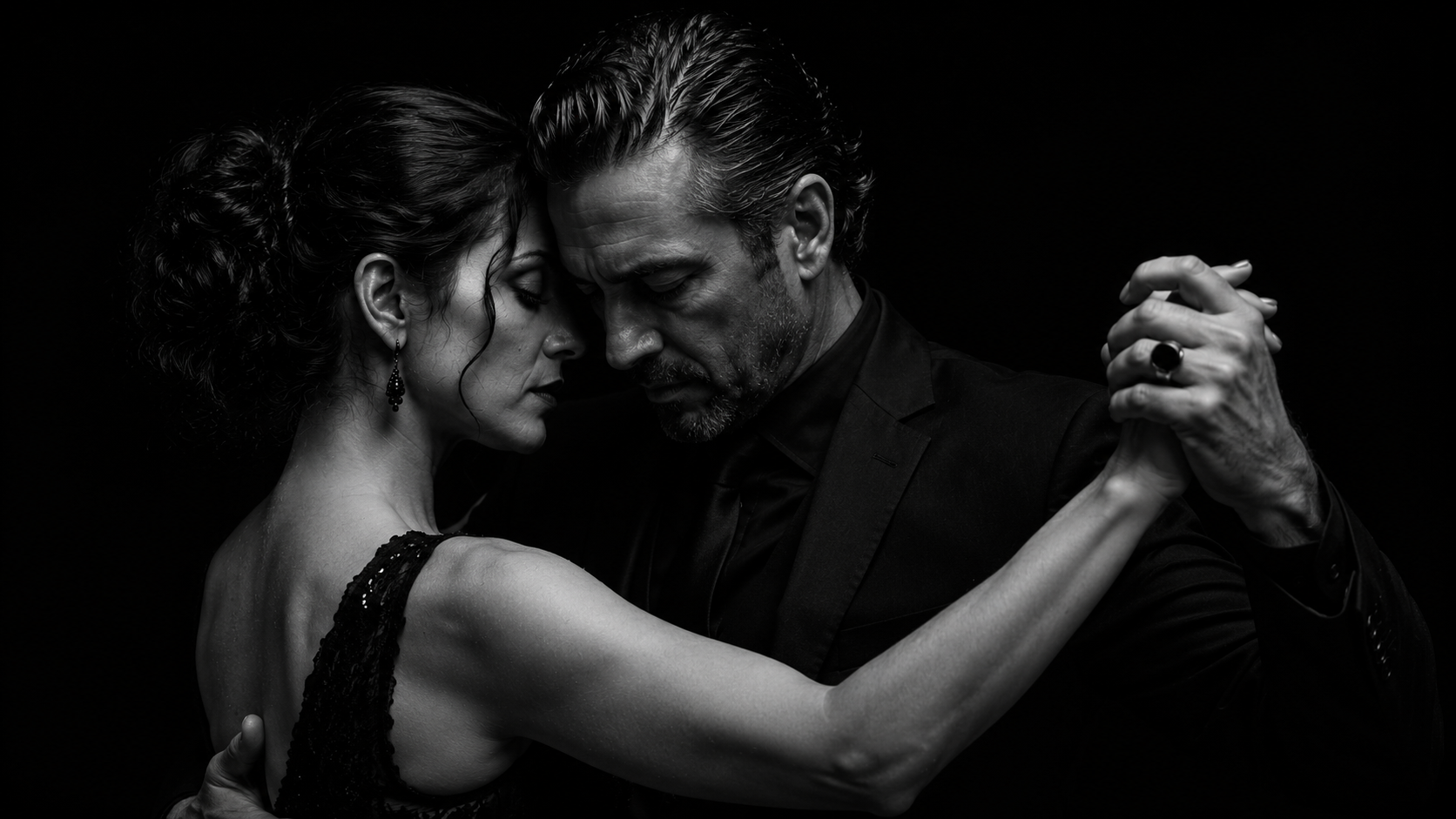
Visual created by Anita Flejter with the use of generative AI tools, inspired by the atmosphere and emotion of Argentine tango.
What the Discomfort Means
The discomfort you feel? That is your brain rewiring. Neurons that used to fire in isolation are learning to fire in sequence. The process is biological, not psychological. You are not lacking talent. You are lacking repetitions. The overwhelm is temporary. The fluency is permanent, but only if you stay in the conversation long enough to earn it.
Keep showing up. Keep having awkward conversations. Keep stepping onto the floor when every instinct says you are not ready. The language is already inside you - your body just hasn't finished translating it yet.