The Invisible Lead: What Actually Happens Inside a Tango Embrace

Most people think the tango embrace is a hug that happens while you dance.
It isn't. The embrace is the dance. Everything else, the steps, the pivots, the decorative kicks, is just output. The embrace is where the information travels.
The embrace is the dance.
If you're a beginner, this probably sounds abstract. You're still trying not to step on anyone. That's fine. But understanding what's happening in the embrace, even roughly, will save you months of confusion. Here's what's actually going on.
Your Body Weight Is Shared Real Estate
Stand in front of a partner and take an embrace. Now shift your weight slightly, maybe 5%, toward them.
If they don't compensate, you both tip. If they do compensate, you're now dancing.
This is the first thing students miss: your axis is not yours alone anymore. In a working embrace, both partners are managing a single, shifting center of gravity. When the leader moves their center, the follower's body rearranges to keep the system upright. When the follower extends a leg, the leader's frame absorbs the feedback.
The embrace is a load-bearing structure. Treat it like one.
What to feel in class: Is your partner's weight leaning on you, or are you both standing independently? There's no single right answer. Different styles use different amounts of shared weight. But you should know which one you're doing. Most beginners default to full independence because it feels safer, and then wonder why nothing communicates.
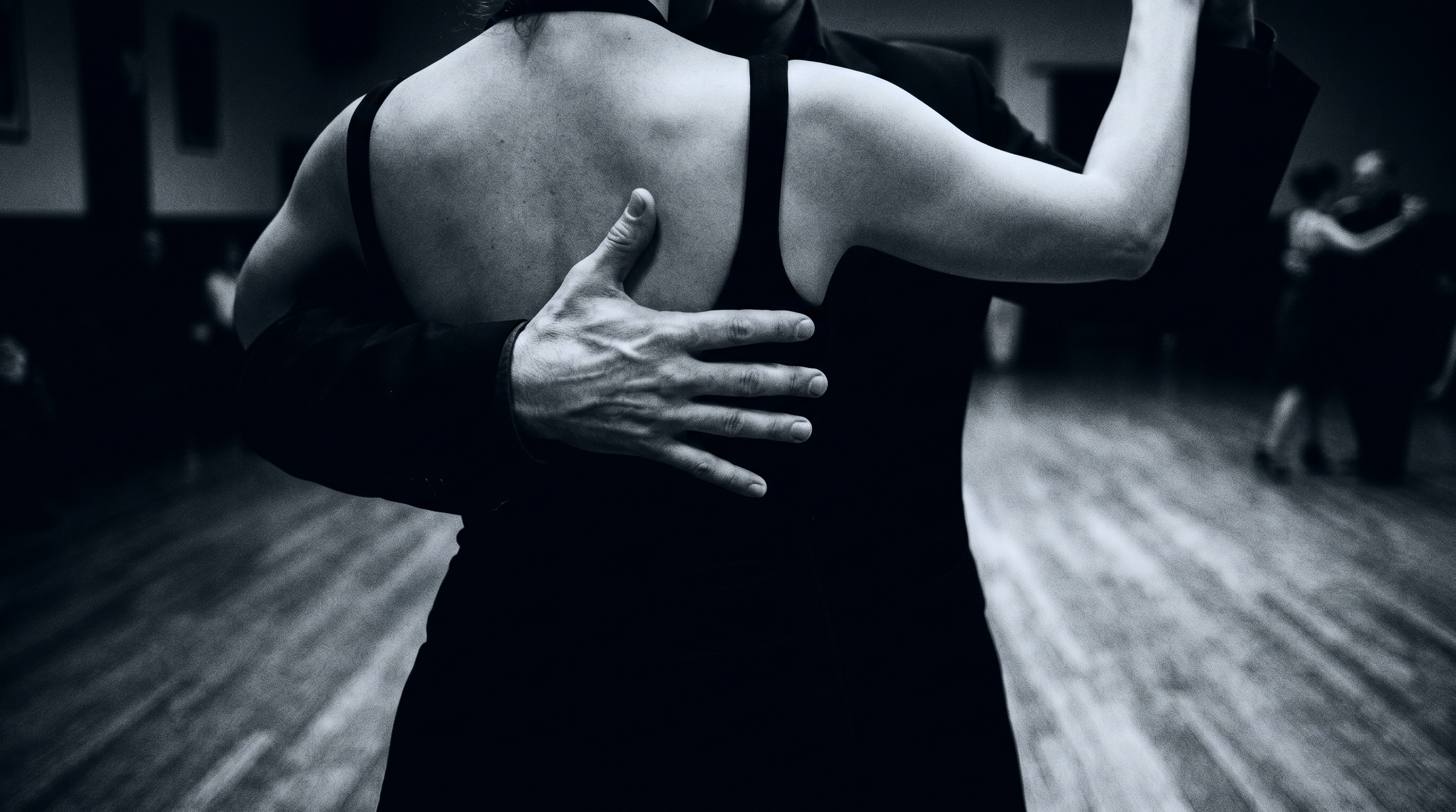
Visual created by Anita Flejter with the use of generative AI tools, inspired by the atmosphere and emotion of Argentine tango.
The Lead Is Not a Push
Beginners often lead by shoving their partner around. Intermediates often lead by indicating what's about to happen with exaggerated prep. Both are wrong, just at different altitudes.
A real lead is a change in your own body that your partner feels and responds to. You don't move them. You move yourself, and the invitation travels through the embrace.
Think of it like this: if you're walking forward and your partner is connected to you, they'll walk backward. Not because you told them to. Because your forward motion created a vacuum they naturally fill to preserve the shared balance.
But movement alone isn't the whole picture. A lead also carries intention - a signal that runs parallel to your body's action, telling your partner not just that something is happening, but what her part in it is. Your movement is your own. Your intention is shared. One without the other either drags her along or leaves her guessing.
What to feel in class: Is your partner reacting to pressure, or to intention? Pressure feels like a shove. Intention feels like gravity tilting. If you're leading, ask yourself: did I actually change my own weight, or did I just try to move their leg? If you're following, ask: did I feel the shift in their center before I stepped, or did I guess?
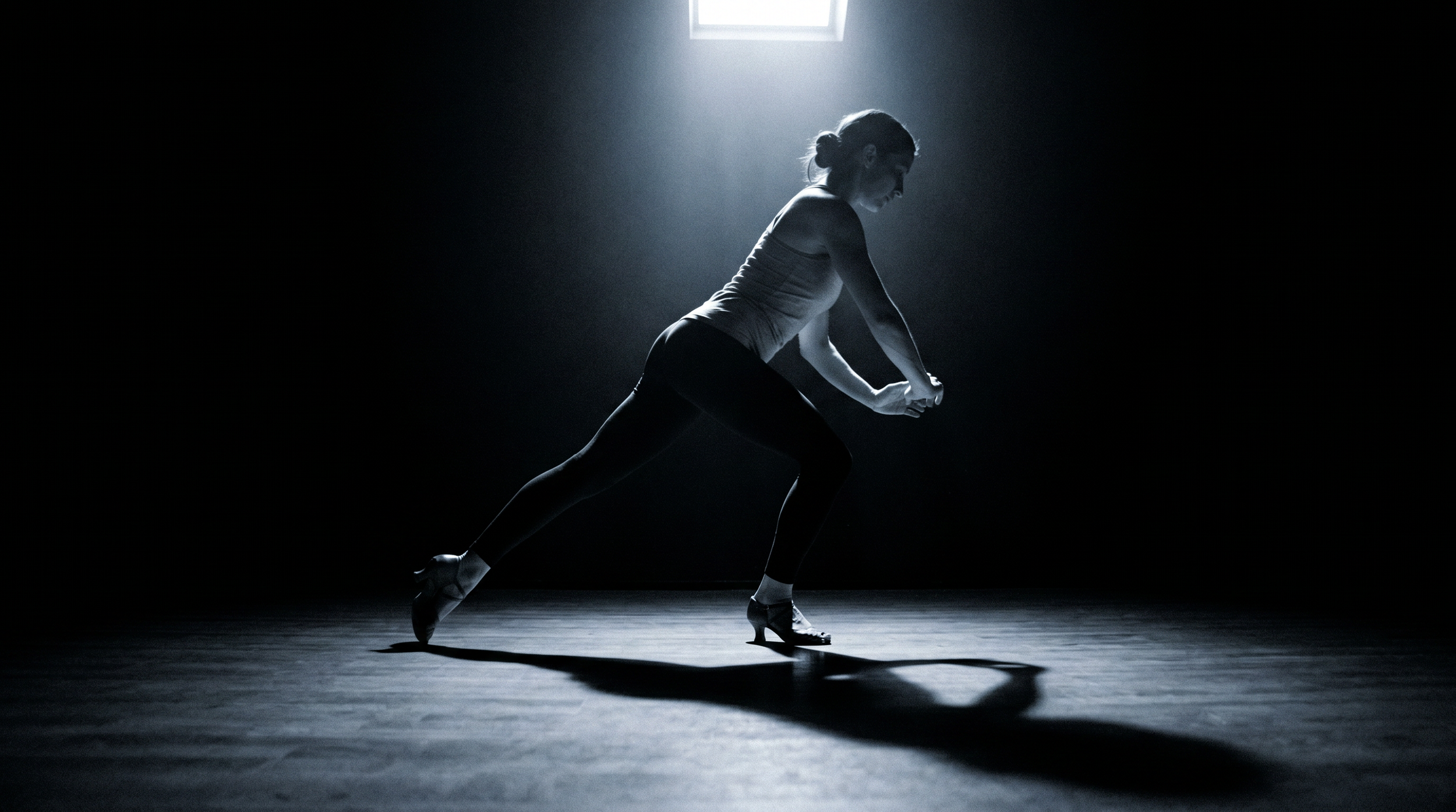
Visual created by Anita Flejter with the use of generative AI tools, inspired by the atmosphere and emotion of Argentine tango.
The Crossed System Is Not a Trick
There's a moment in tango where the leader steps outside the follower on their right side. The follower steps forward on their left. Both step with the same foot. This is the crossed system, and it's where most beginners freeze.
The freeze happens because it feels like the rules changed. In parallel system, you mirror each other. In crossed, you don't. But mechanically, nothing changed. The leader still shifted their weight, the follower still felt it and filled the space.
The crossed system is not a trick step you memorize. The feet are still walking exactly as they always do - one in front of the other. What changed is the tracks. When walking outside partner, both right feet share one track, and both left feet enjoy a separate track to the outside. Three tracks instead of two.
This happens because one partner took an extra step, and that extra step shifted the foot relationship. What was mirrored is now matched. The embrace transmits the same information it always did; the legs just arrive somewhere different.
What to feel in class: Can you tell, from the embrace alone, whether you're in parallel or crossed? Most beginners can't, and that's the problem. They rely on visual cues, "I see my foot going there," instead of proprioceptive ones. Close your eyes during practice. If the structure collapses without sight, the embrace isn't carrying enough information.
The Embrace Transmits the Beat Before the Step
In musicality classes, teachers talk about dancing on the beat, or between the beats, or anticipating the beat. All of this is easier to understand if you stop thinking about feet and start thinking about the embrace.
The music doesn't tell your feet when to move. It tells your center when to shift. The shift travels through the embrace as a preparatory signal, a micro-adjustment, a breath, a change in tone. Your partner feels the music through your body before your leg completes the step.
This is why dancing with a partner who hears the music differently feels so disorienting. It's not that their feet are off. It's that their center is transmitting a different rhythm through the embrace, and your nervous system is trying to reconcile two conflicting signals.
What to feel in class: Can you hum the melody while you dance? Not to perform, but to test whether your body is actually connected to the music or just executing steps in time. If the embrace is transmitting musicality, your partner should feel the phrase structure before you step it.
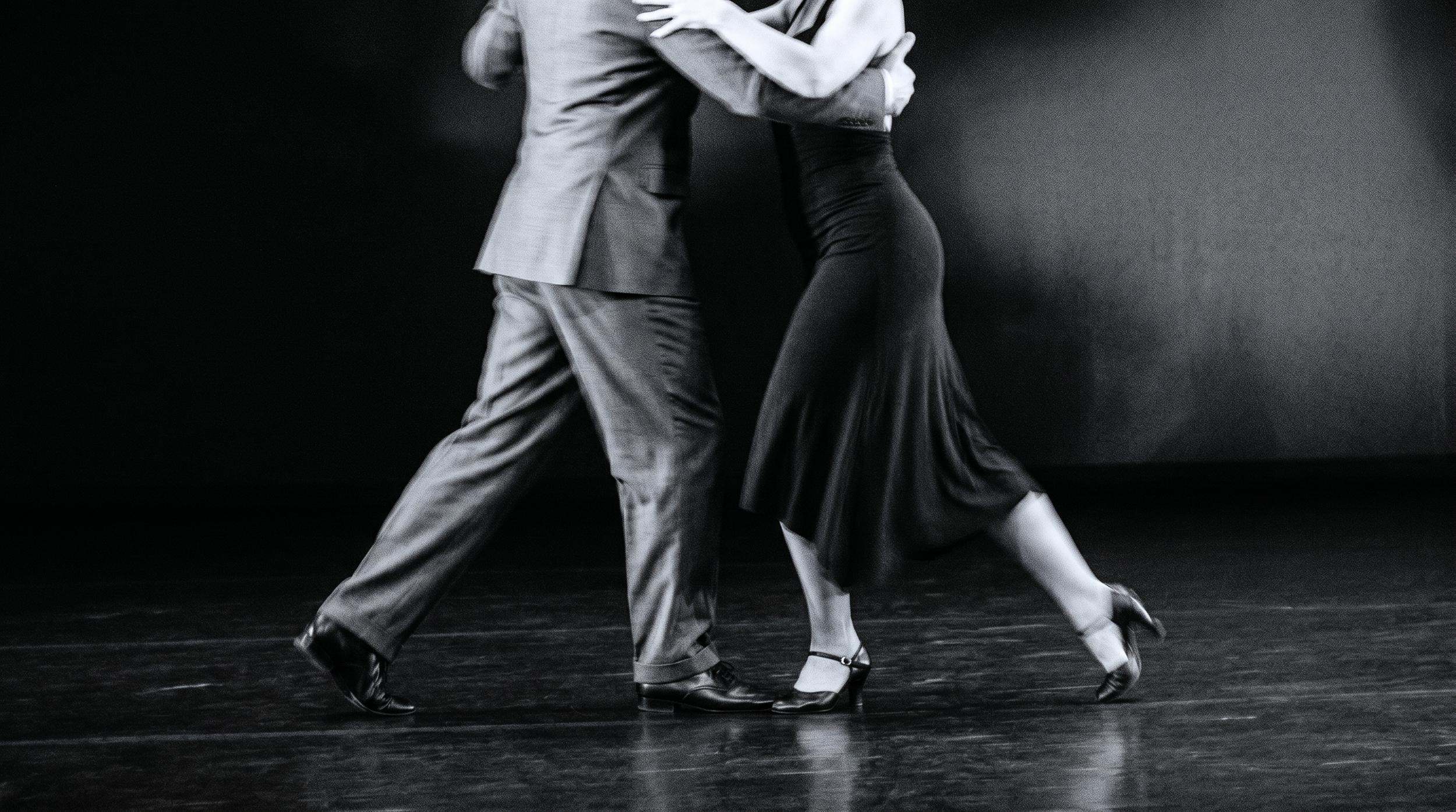
Visual created by Anita Flejter with the use of generative AI tools, inspired by the atmosphere and emotion of Argentine tango.
Practical Checks for Your Next Practice
These aren't exercises. They're diagnostics. Use them to figure out what's actually happening.
The suitcase test: If someone put a heavy suitcase in your leading arm, could you still lead? If not, you're using arm tension instead of body weight. The lead should travel through your torso, not your bicep.
The closed-eyes follower: Follow with your eyes closed for an entire song. If you feel lost, the embrace is either too light, too rigid, or too inconsistent to read. That's a leader-side issue.
The one-foot check: Can you pause on one foot for a full phrase without either partner clutching? If not, the shared axis isn't balanced. Someone is holding the other up.
The no-hands test: Stand in practice embrace, chest contact, no arms, and walk. If the structure falls apart, your arms were doing structural work they shouldn't be doing.
The Hard Truth
Most tango frustrations, feeling lost, feeling pushed, feeling like you and your partner are dancing different songs, come from the same place. The embrace is carrying too little information, or the wrong kind, or it's carrying it through force instead of structure.
You can spend years collecting steps. Steps are easy to teach and satisfying to learn. But the embrace is the operating system. If the OS is buggy, the apps don't run.
The good news: the embrace is improvable at every level. You don't need better technique to build a better embrace. You need better attention.
What are you feeling in your embrace that you can't explain? Bring it to class. There's a mechanical reason for almost everything, and half the job of learning tango is learning to name what your body already knows.