Tango Is Cliquey. Just Not for the Reason You Think.

Every milonga looks like it has a private club. It does, sort of. But the membership rule is not what you assume, and the door is not locked.
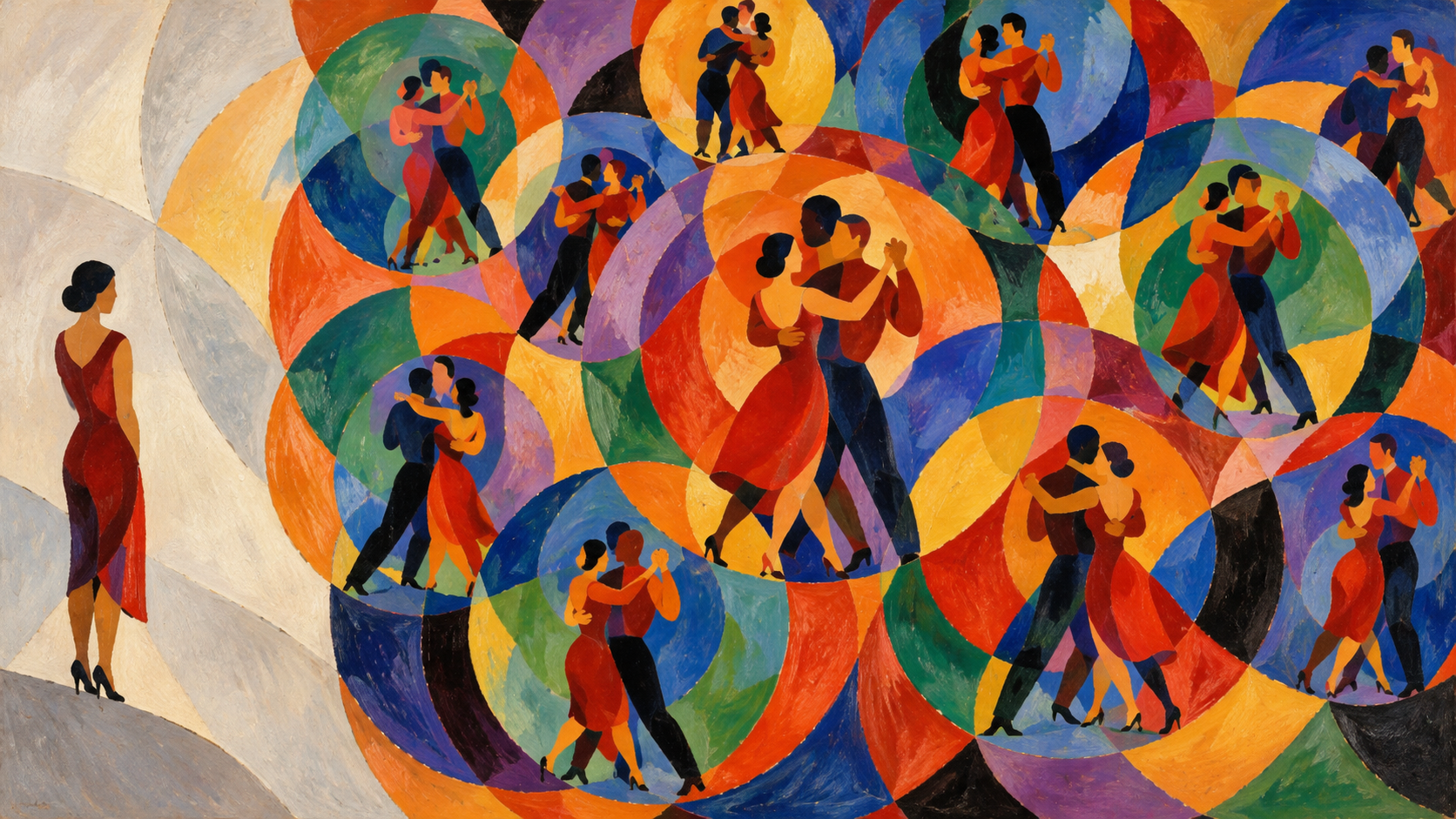
Every milonga has a moment like this. You are standing by the edge of the floor, pretending to listen to the music, and across the room someone gets up for the third tanda in a row. They never looked at you. They greeted three people by name on the way to their table. They are, you are fairly certain, part of a clique.
And here is what your brain does with that information: it picks a reason. You are too old. Too young. Wrong clothes. Wrong shoes. Not thin enough, not confident enough, not known enough. Your brain is a very fast and very unkind detective, and it always closes the case before lunch.
Visual by Anita Flejter, created with generative AI tools. Inspired by the atmosphere of Argentine tango and the paintings of Sonia Delaunay.
I have watched this happen for years, and I will tell you what I have learned from both sides of it, because I have been the person standing at the edge of the floor, and I have been the person greeting three people by name.
The reason is almost never the one you picked. The thing the milonga actually sorts on is not age, looks or wardrobe. It is level. Once you see it, the whole social map of the room rearranges itself.
The growth zone
Visual by Anita Flejter, created with generative AI tools. Inspired by the atmosphere of Argentine tango and the paintings of Sonia Delaunay.
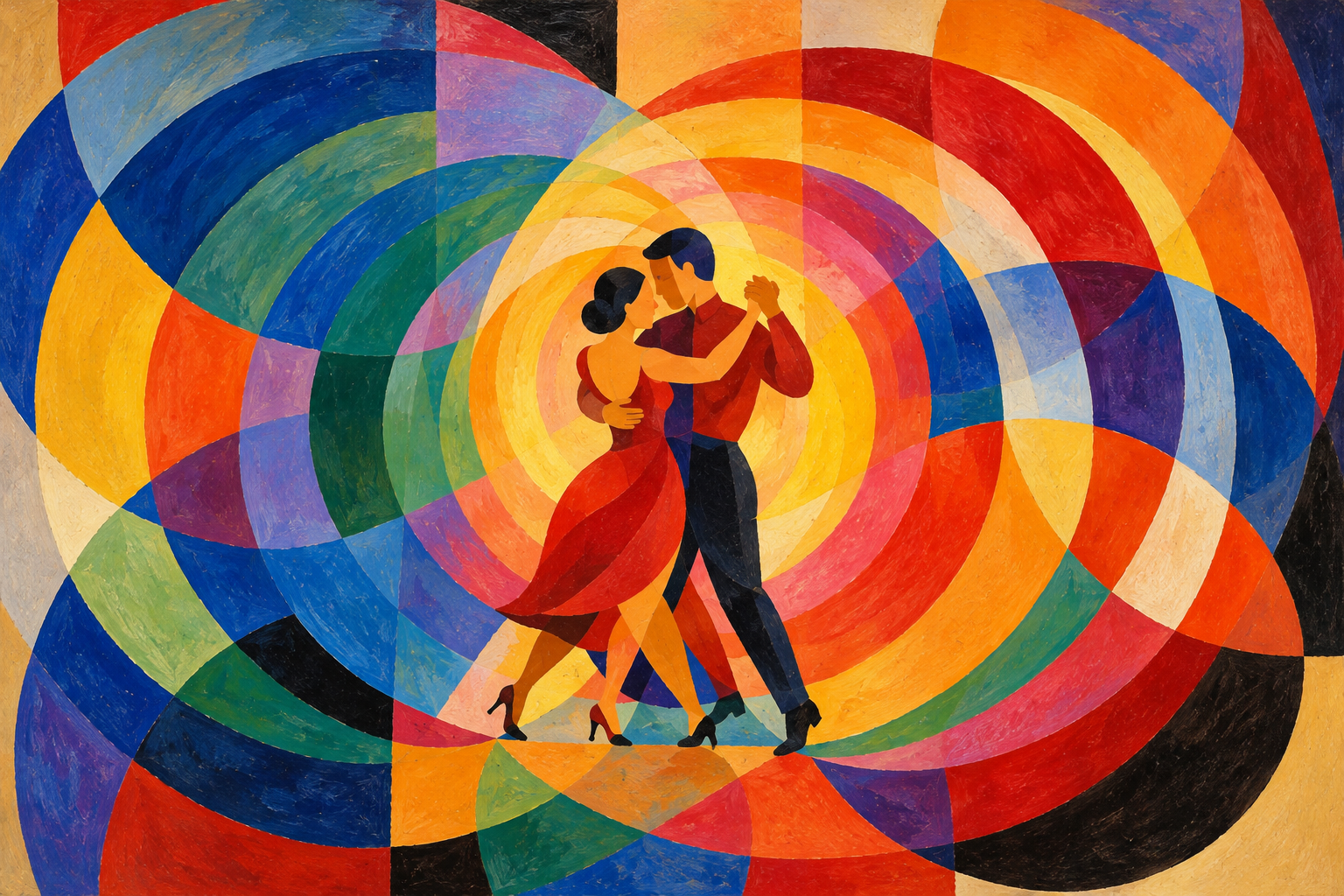
Forget cliques for a second and think about a single tanda between two people of different levels.
When the gap is small, with one of you slightly better than the other, something good happens. The stronger dancer relaxes, because nothing being led or followed is beyond them. The newer dancer stretches, reaching just past their comfort zone, and the presence of a solid partner is exactly what makes the reaching possible. This is the growth zone. Both people feel it. It is the tanda that leaves the newer dancer buzzing and the more experienced one saying, and meaning it, “that was lovely.”
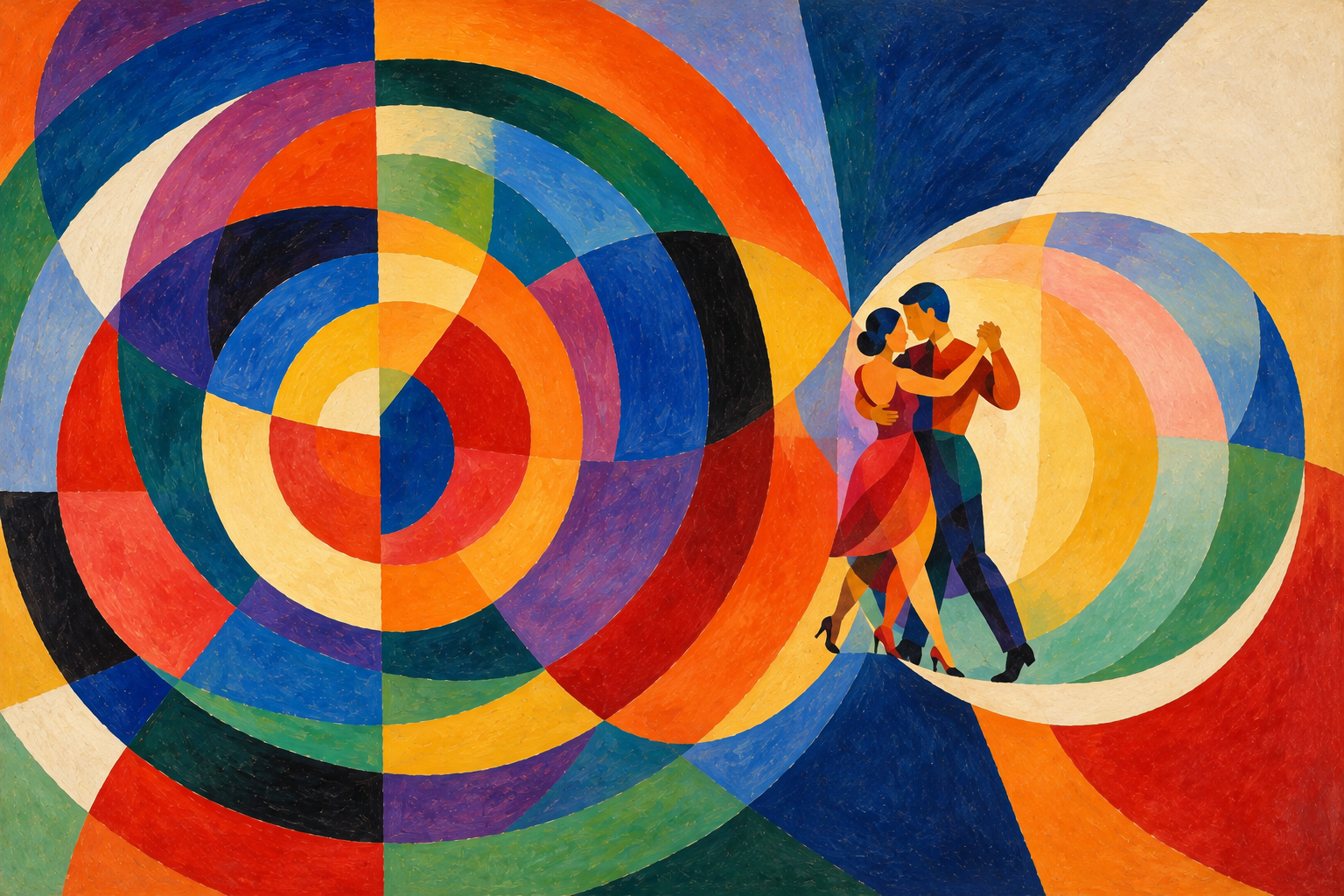
Now widen the gap.
Visual by Anita Flejter, created with generative AI tools. Inspired by the atmosphere of Argentine tango and the paintings of Sonia Delaunay.
When one dancer is far above the other, the tanda becomes hard work, and notice: for both of them. This is the part beginners never believe, so hear it from someone who has been the far-above dancer more times than I can count. Dancing far below your level is not relaxing. The advanced leader spends three songs managing, simplifying, protecting, choosing vocabulary the follower can actually receive. The advanced follower spends three songs waiting, dampening her own dance so that unclear signals do not turn into chaos. Neither person is dancing. Both are working. It is generous, it is kind, and it is tiring in a way that twelve minutes has no right to be.
There is also a subtler cost, and this one matters more. At a large level gap, the risk of misunderstanding spikes. He leads something, her body does something else. He concludes she ignored it, she concludes she failed. Both walk away slightly bruised, and neither is wrong. Wide gaps are not just effortful. They are ambiguous. The embrace carries less information accurately the further two dancers are from a shared language, and tanda after tanda of ambiguity quietly teaches the advanced dancer to avoid the gap.
Psychologists got there before the milonga did
Visual by Anita Flejter, created with generative AI tools. Inspired by the atmosphere of Argentine tango and the paintings of Sonia Delaunay.
None of this is a tango invention. Two of the best-known ideas in psychology describe the growth zone almost exactly.
In the early 1930s, the Russian psychologist Lev Vygotsky described what he called the zone of proximal development: the space between what a learner can do alone and what they cannot do even with help. In between sits everything they can do with a more knowledgeable partner. That is where learning happens. (Wikipedia) Vygotsky was writing about children and teachers, not about tango, but he could have been describing a good tanda: you, a slightly better partner, and a step you could not quite do last week.
Fifty years later, the psychologist Mihaly Csikszentmihalyi studied what he called flow, the state of being completely absorbed in what you are doing. His research found that flow appears when the challenge of an activity roughly matches your skill. Too much challenge and you slide into anxiety. Too little and you slide into boredom. (ASCD)
Put a wide level gap through that lens and you can see the problem precisely. In the same embrace, one dancer is in anxiety and the other is somewhere between boredom and babysitting. Nobody is in flow. And flow is the whole reason most of us come to a milonga at all.
Community service
And then there is the phrase you will hear at milongas, usually whispered with a grin: dancing far below your level is called community service.
I want to handle this one carefully. If you are newer, you have probably been on the receiving end of the phrase, or worse, on the receiving end of a tanda that felt like it. So let me say the true thing first: everyone on the floor has been on both sides of this. Me included. When I was new, there were patient, generous dancers who carried me through tandas I had no business surviving, and they did it without a flicker of condescension. I owe those people my tango. Now, on my better nights, I try to pay it forward, and I hope the people I dance with feel the same grace I felt.
But. Community service is real, and pretending otherwise does not help anyone. A tanda far below your level is an act of generosity, and like every act of generosity, it draws on a limited account. Nobody can spend their whole night that way and still call it a party. A milonga where the advanced dancers dance only as charity is a milonga that burns out its best people, and teaches its newest ones that being danced at is normal. A night can hold a few of these tandas. It cannot be built from them.
This is not snobbery. It is arithmetic. (Also, unlike court-ordered community service, this kind comes with nice shoes and a bandoneón. Nobody is complaining that much.)
Cliques are gravity, not gates
Visual by Anita Flejter, created with generative AI tools. Inspired by the atmosphere of Argentine tango and the paintings of Sonia Delaunay.
Now put the whole room together.
Every dancer drifts toward tandas in their growth zone: slightly above, slightly below, comfortable. Those zones overlap with the zones of certain other dancers, again and again, night after night. Repeat something eighty times and you do not get a conspiracy. You get a clique. Or rather, something that looks like a clique from the outside, because from the outside you cannot see the level geometry. You only see the clustering, and you invent a reason for it.
Social science has a name for each half of this. Sociologists call the tendency to bond with people similar to us homophily, and it is one of the most consistent findings in the study of social networks: similarity breeds connection. (McPherson, Smith-Lovin and Cook, 2001) On a tango floor, the similarity that matters most is not age, income or taste in shoes. It is a shared dance language.
The other half is plain proximity. In 1950, the psychologists Leon Festinger, Stanley Schachter and Kurt Back studied friendships in a student housing complex at MIT. One of their findings: residents who lived near a stairway made more friends on other floors than residents who lived farther away, simply because they crossed paths more often. (Wikipedia: Propinquity) Friendship followed the architecture.
A milonga has stairways too. They are called classes and practicas. The people who seem to belong to the clique are mostly the people who keep walking past each other on those stairs.
Usually, though, the reason we invent is the cruelest one available: age. I wrote recently about how five generations hear five different songs on the same floor, and I will add this here because it matters: it is not because she is younger. Or older. A 24-year-old who has spent two years in practicas gets asked constantly. A 24-year-old in her third month sits out just as often as a 55-year-old in his third month. The room is not sorting by birth year. It never was. It is sorting by shared language, and shared language is built by dancing together in the stretch zone, one tanda at a time.
The question that actually matters
So here is the reframe, and it is the whole point of this post.
The painful question is “Why won’t they dance with me?” It has no answer, because it assumes the sorting is done to you, by their taste, their bias, their clique.
The useful question is “Am I in anyone’s growth zone?” That one has an answer, and the answer is in your hands.
A growth zone is not a fixed location. It moves when you move. Every clean ocho, every tanda where your following stopped guessing and started receiving, every tanda where your lead came from your chest instead of your arms, every practica where you worked on boring fundamentals instead of collecting new figures: all of it moves you into new zones and widens the circle of people for whom a tanda with you is a pleasure rather than a project.
That is the good news hiding inside the clique. The gate is not guarded. It is a slope, and you climb it by improving.
And there is a second lever, equally in your hands, that almost nobody pulls on purpose: dance with people slightly below you. Not as charity. As strategy. Every tanda you give someone in their growth zone is a tanda they remember, and dancers remember who stretched them kindly. They will be better next year, and they will remember you then too. The people above you pull you up. The people below you pull you in. The circle widens from both directions at once.
How to widen your circle

Visual by Anita Flejter, created with generative AI tools. Inspired by the atmosphere of Argentine tango and the paintings of Sonia Delaunay.
Some practical moves, for any role and any level:
• Take the stairs. Go to practicas, not only milongas. A practica is where shared language gets built without the pressure of a full room watching. At Ultimate Tango that is Che Tango Practica on Saturdays and our Tuesday practicas, and it is where most of our “cliques” were born.
• Take one class slightly above your level. Not three levels above. One. Then you are standing in the growth zone of everyone else in that room.
• Learn the cabeceo. In Buenos Aires, dancers invite each other with a glance and a nod across the room, and accept or decline the same way, so nobody has to walk across the floor and risk a public no. (Wikipedia: Milonga) It is not only good manners. It lets people say yes to you at the right tanda, to music they love, instead of a polite yes at the wrong one.
• Ask your teacher for an honest read. “Where am I, really, and what is the one thing that would move me?” It is the most useful question you can ask, and most students never ask it.
• Be good company off the floor. Reputation travels between tandas. People ask the people they enjoyed talking to.
• Remember the arithmetic in both directions. If you are experienced, give the room a few generous tandas every night. If you are newer, do not take a declined cabeceo as a verdict. It is usually about the tanda, the music or the hour, not about you.
The view from inside
Visual by Anita Flejter, created with generative AI tools. Inspired by the atmosphere of Argentine tango and the paintings of Sonia Delaunay.
One last thing, from the inside of the so-called clique: we are not having the night you think we are having.
The dancers who seem to own the room are not coasting in a private club. They are doing the same arithmetic you are: scanning for tandas in their zone, taking the occasional community service tanda and hoping it lands kindly, declining people gently, and getting declined themselves far more often than you would guess. Yes, the clique gets turned down too. We just do not post about it.
The only real difference is that their zones are wider, because their level is higher, and from the outside wide zones look like popularity.
The room is not closed. It is layered. And layers, unlike gates, can be climbed.
Sources
• Vygotsky’s zone of proximal development: Wikipedia
• Csikszentmihalyi on flow, challenge and skill: ASCD
• McPherson, M., Smith-Lovin, L. and Cook, J. M. (2001). Birds of a Feather: Homophily in Social Networks. Annual Review of Sociology 27. Duke Scholars
• Festinger, Schachter and Back (1950), the Westgate housing study: Wikipedia: Propinquity
• The cabeceo: Wikipedia: Milonga (dance event)