
Tango Is Not a Dance of Passion

There is a scene in Scent of a Woman (1992) that single-handedly recruited more beginners into tango schools than any advertisement before or since. Al Pacino, blind and volatile, pulls a stranger into his arms in the middle of a hotel dining room. The orchestra strikes up Por una Cabeza. He leads her through a dramatic, chest-out sequence while murmuring, ‘No mistakes in the tango, not like life. For seven minutes, tango is sold as pure, smoldering passion - the red dress, the dip, the intensity that needs no technique because feeling is enough.
It is a beautiful lie. And it has done real damage.
Tango is not a dance of passion. It is a dance of geometry, timing, and tension management.
The sooner a beginner understands this, the sooner they stop gripping their partners too hard, anticipating instead of listening, and mistaking intensity for clarity. Passion is not the fuel. It is, at best, the exhaust.
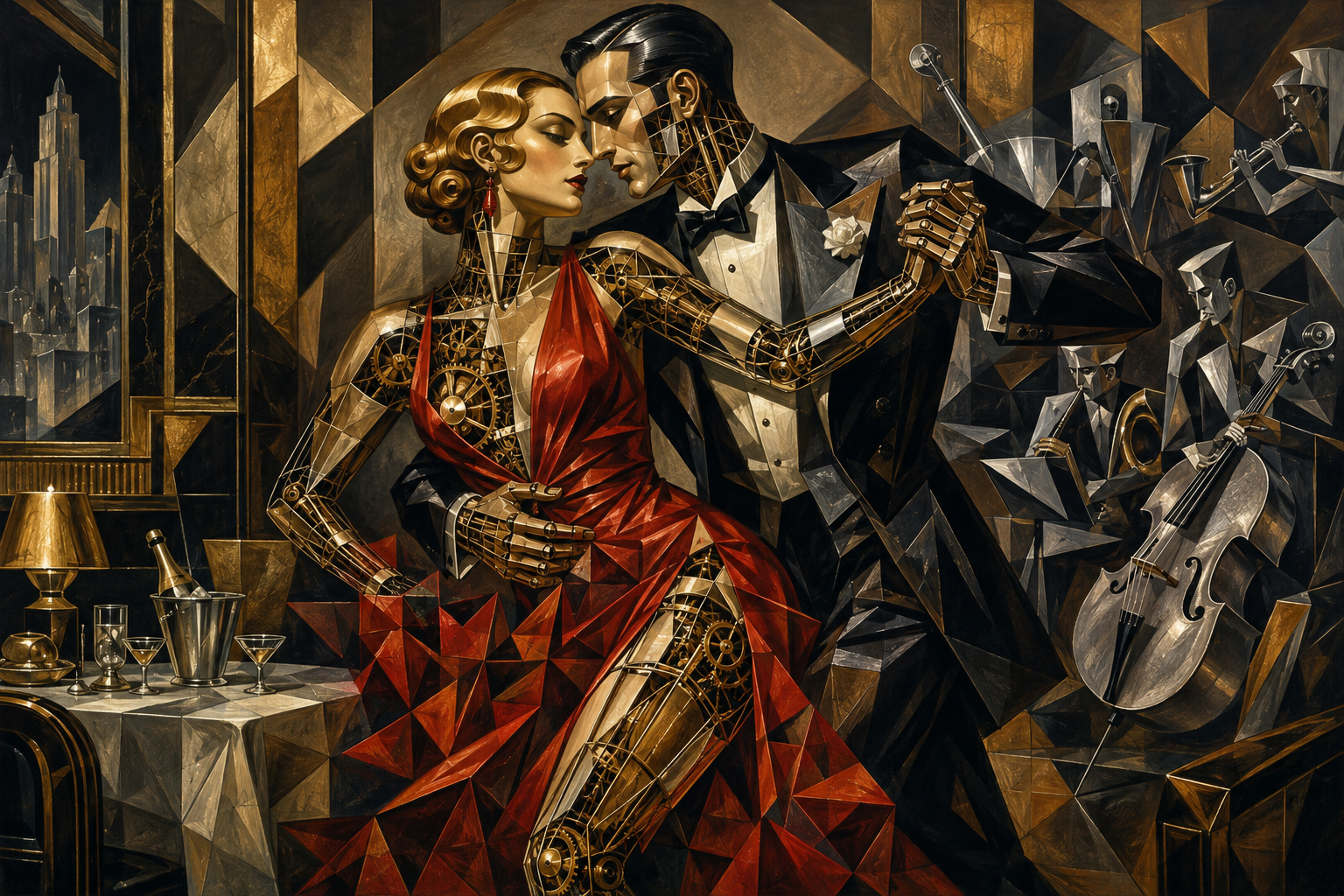
Visual created by Anita Flejter with the use of generative AI tools, inspired by the atmosphere and emotion of Argentine Tango.
The Marketing vs. The Mechanics
The romantic packaging of tango is not accidental. Kathy Davis, in her 2015 paper ‘Should a Feminist Dance Tango?’ published in Feminist Theory, notes how tango is invariably performed as "the epitome of passion" - sweeping movements, entangled legs, sensuous gazes, and the cat-and-mouse of approach and retreat. This is what sells postcards in Buenos Aires and fills Hollywood frames.
But Davis, a critical sociologist, points out the cost: the performance of passion is inseparable from ‘feminine subservience and masculine machismo.’ When we buy the passion narrative, we are buying a gendered script that has almost nothing to do with what happens in a well-run milonga.
What actually happens in the milonga is closer to applied physics than romance.
Consider the forward step. It looks simple: one person walks, the other walks. But as Chatfield, Krasnow, Herman, and Blessing demonstrated in their 2007 biomechanical study of tango dancers, elite leaders and beginners show fundamentally different sway patterns during weight transfer. Both groups sway, but elite dancers exhibit anterior sway twice as large as their posterior sway before stepping, landing close to vertical at resolution. Beginners do the opposite. The elite dancer is not more passionate. She is more precise in how she manages her center of gravity over her base of support.
Kenneth Laws, in his foundational book Physics and the Art of Dance (Oxford University Press, 2002), puts it in terms any engineer would recognize: a dancer's center of gravity must remain above the area of contact with the floor, or torque will tip them over. When two dancers share an axis in close embrace, this becomes a coupled system. The combined center of gravity shifts as a single unit. If one partner pushes without structural alignment, the system destabilizes.
There is no amount of passion that can violate Newton's third law.

Visual created by Anita Flejter with the use of generative AI tools, inspired by the atmosphere and emotion of Argentine Tango.
The Geometry of Two Bodies
Tango operates in Euclidean space, whether we like it or not.
Every movement is a vector with magnitude and direction.
The leader's intention must be transmitted through a shared frame - the embrace - as a force vector. The follower must interpret that force, adjust her own base of support, and move her center of gravity along a path that maintains equilibrium.
Think of it like sailing. The wind is not passion. It is force. The sailor who treats it as romance will capsize. The sailor who understands vectors, pressure, and hull geometry will move. In tango, the ‘wind’ is the leader's intention; the ‘hull’ is the follower's frame and axis. When both are properly aligned, the result feels effortless. But the effortlessness is an illusion produced by correct mechanics, not by feeling strongly about your partner.

Visual created by Anita Flejter with the use of generative AI tools, inspired by the atmosphere and emotion of Argentine Tango.
Sally Potter's 1997 film The Tango Lesson captures this tension honestly. Potter, a filmmaker, tries to learn tango from Pablo Veron, one of the great dancers of his generation.
She wants the passion. He gives her the walk.
The film dramatizes the reality that tango technique is maddeningly specific - the placement of the foot, the angle of the torso, the exact tone of the embrace. At one point, Veron tells her that to dance well, she must stop trying to express and start trying to be correct. The art emerges from the constraint, not from the desire to be artistic.
This is the opposite of the Scent of a Woman fantasy. Pacino's character does not know technique; he knows confidence. The film suggests that is enough.
In real life, confidence without alignment is just a leader who pulls his follower off her axis.
What We Actually Do Wrong
The passion narrative sets dancers up for a specific set of failures. The leader believes his job is to impel - to transmit emotion through force. He grips the follower's back like a steering wheel. He steps larger than his axis allows, pulling her with him. He confuses musical intensity with physical pressure. The follower, meanwhile, may believe her job is to receive passion - to be light, agreeable, emotionally open. She collapses her frame. She stops maintaining her own axis because she thinks "connection" means melting into her partner.
Both are dancing a fantasy. Neither is dancing tango.
In a 2019 study published in Scientific Reports on the kinematics of perceived coordination in dance, researchers found that observers rate dyadic coordination as ‘good’ when dancers exhibit high torso orientation, temporal coupling, and spatial coupling. These are measurable kinematic variables. They have nothing to do with eye contact. Nothing to do with drama. The study used motion capture to show that what looks "connected" from the outside is, at the biomechanical level, a matter of aligned vectors and synchronized timing.
Dancers who chase passion are chasing a ghost.
The ghost looks great in movies.
It feels terrible on the dance floor.
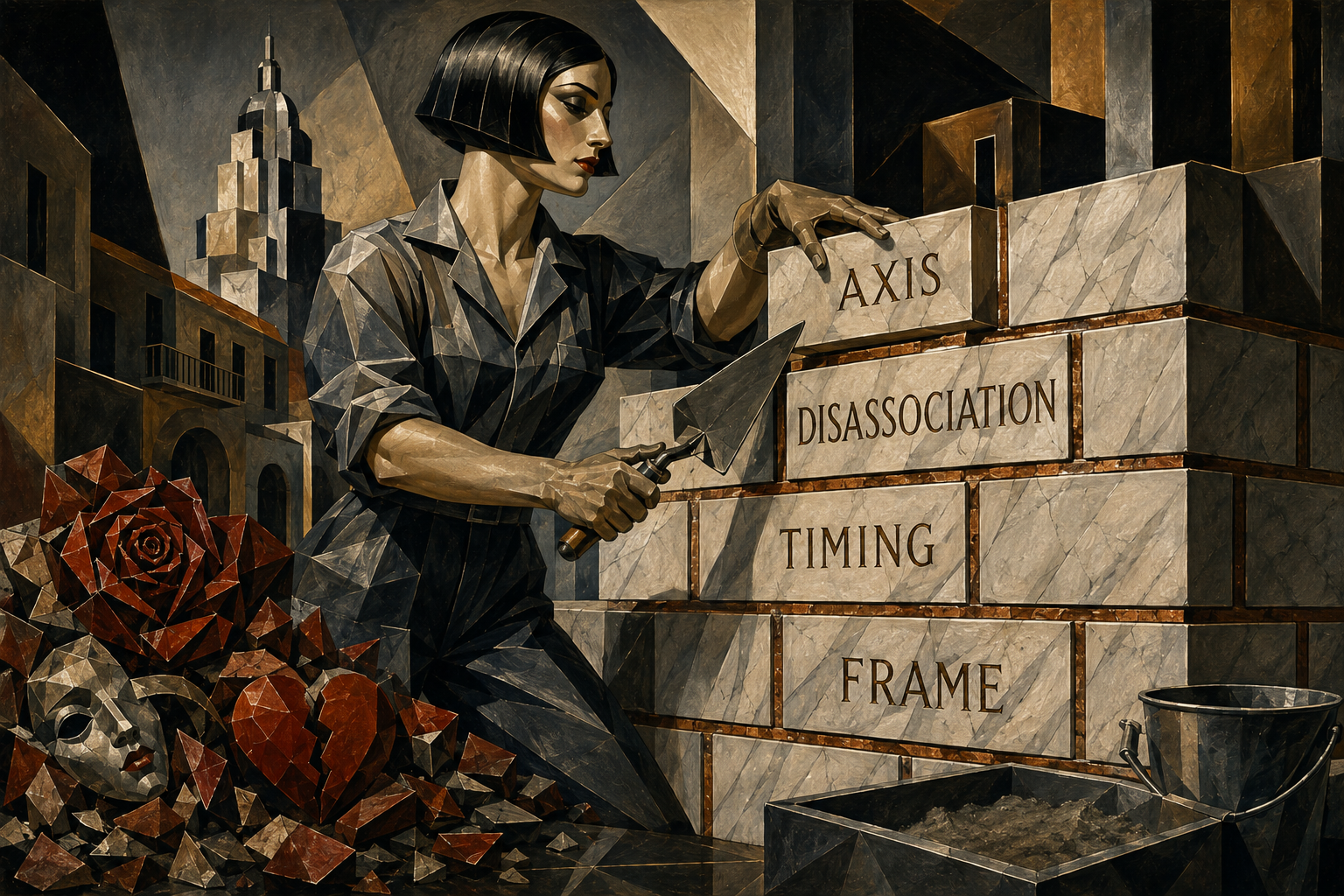
Visual created by Anita Flejter with the use of generative AI tools, inspired by the atmosphere and emotion of Argentine Tango.
The Brick Wall
I watched a neighbor try to build a garden wall once. He was enthusiastic - the kind who believes a project succeeds if you want it badly enough. He stacked bricks without a level, without mortar lines, without checking the foundation. He was convinced that determination would keep it standing. It leaned. It cracked. It fell. Think about it.
You can't will a wall into standing. It doesn't care about your enthusiasm. It cares about plumb lines, compression strength, and whether the base is level.
Tango is the same. The ocho does not care that you feel the music deeply. It cares whether your hip is stacked over your standing leg, whether your free leg extends from the hip without dragging your torso, whether your dissociation is clean enough to allow the upper body to remain facing your partner while the lower body turns. These are mechanical facts. You can learn them with a good teacher and a mirror. You cannot learn them by wanting them harder.
When Passion Arrives
I am not saying tango is emotionless. I am saying the emotion is a byproduct.
When two people move as a single mechanical system - when the leader's intention is clean, the follower's response is grounded, and the music is heard not as a soundtrack but as a metronomic structure to be inhabited - something else arrives. It is not passion in the Hollywood sense. It is something quieter: the satisfaction of competence shared. The pleasure of not having to think. The rare experience of two bodies operating in phase, like coupled oscillators.
Physicists call this resonance. Dancers call it connection. It happens when the geometry is correct. It almost never happens when you are trying to be passionate.
There is a reason the old milongueros of Buenos Aires do not talk about passion. They talk about the walk. They talk about the floor. They talk about the embrace as something you build, like a cabinet, joint by joint, until it holds. The cabinet does not love you back. But if you build it well, it will not collapse.
Tango is not a dance of passion. It is a dance of structure. And if you build the structure, the feeling will find its own way in.
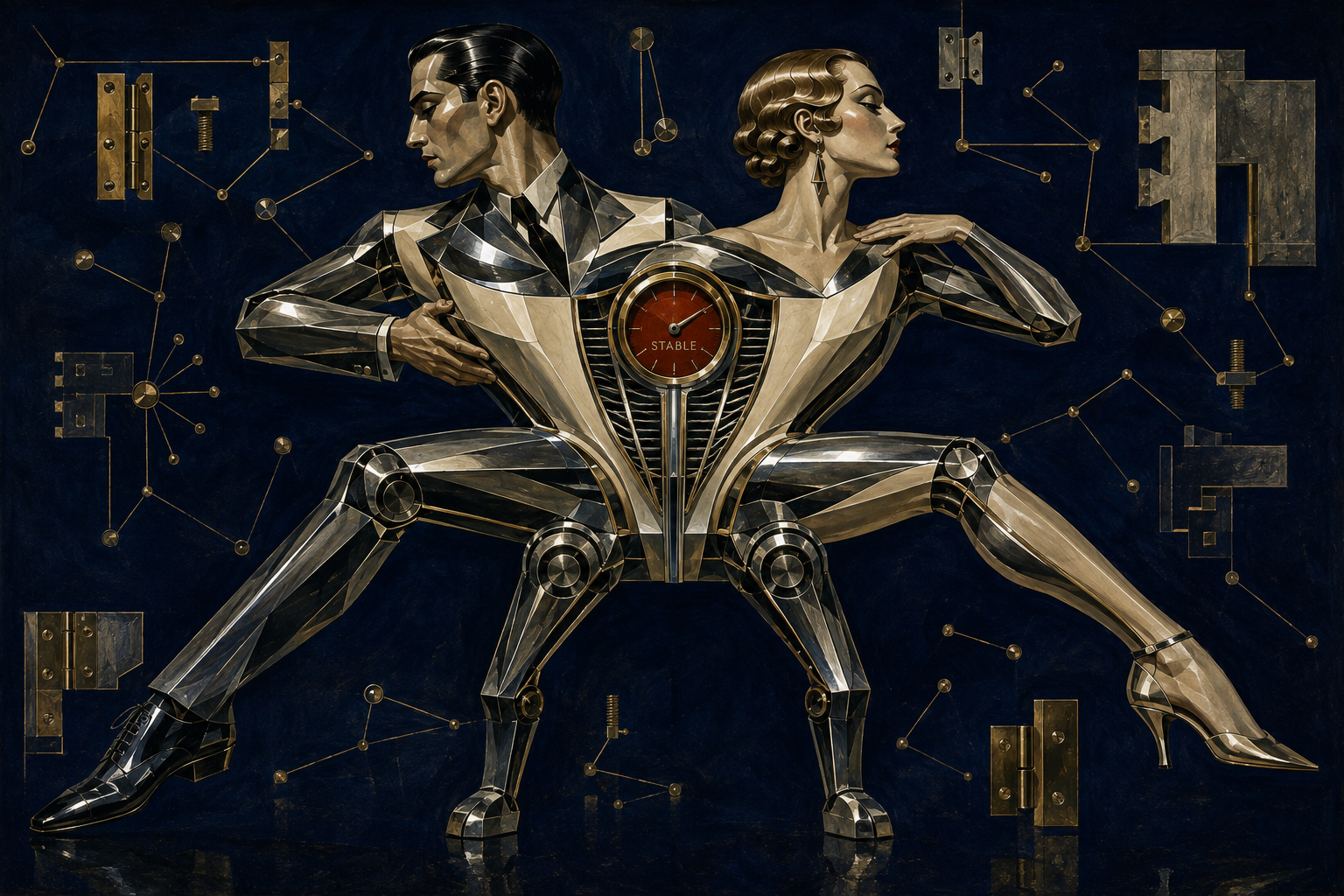
Visual created by Anita Flejter with the use of generative AI tools, inspired by the atmosphere and emotion of Argentine Tango.
Sources:
Davis, Kathy. (2015). "Should a Feminist Dance Tango? Some Reflections on the Experience and Politics of Passion." Feminist Theory, 16(1), 3-21. DOI: 10.1177/1464700114562525
Laws, Kenneth. (2002). Physics and the Art of Dance: Understanding the Moving Body. Oxford University Press.
Chatfield, S.J., Krasnow, D.H., Herman, A., & Blessing, G. (2007). "Biomechanical Analysis of Torso Sway in Forward Step." Journal of Dance Medicine & Science.
Kirschner, S., & Tomasello, M. (2019). "Kinematics of Perceived Dyadic Coordination in Dance." Scientific Reports. https://www.nature.com/articles/s41598-019-52097-6
Potter, Sally. (1997). The Tango Lesson. Sony Pictures Classics.
Brest, Martin. (1992). Scent of a Woman. Universal Pictures.