
Close Embrace Is Not Intimate

The first time I danced close embrace with a stranger, I did not know where to look. Our chests were touching. I could feel his heartbeat, or maybe my own, amplified by the contact. My hand rested on his back. His arm circled my shoulder blades. For three minutes, we were closer than I had been to some people I had dated.
And yet I knew nothing about him. Not his name, not his job, not whether he was kind.
This is the paradox of close embrace: maximum physical proximity, minimum emotional information. The tango community treats this as normal, even beautiful. But we rarely talk about what happens when the two are confused - when a dancer mistakes chest-to-chest contact for emotional intimacy, and begins to behave as if the embrace grants permission the dance does not.
Close embrace is a technical choice,
not an emotional state.
Understanding the difference is not pedantic. It is the line between a safe milonga and a creepy one.

Visual created by Anita Flejter with the use of generative AI tools, inspired by the atmosphere and emotion of Argentine Tango.
What Close Embrace Actually Is
In tango, the embrace is the primary channel of communication. But communication here is not metaphorical. It is mechanical. As Vladimir Lapin notes in his 2016 thesis on tango, the embrace functions as a physical frame through which partners convey information about weight, force, and orientation. Tango dancers lean forward from the hips, creating what Lapin calls a ‘mutually inward, leaning, pushing frame ’- fundamentally different from the outward "pulling" frame of swing, salsa, or waltz.
This inward frame is why close embrace works. The leader's chest transmits direction through pressure and release. The follower's torso receives that information and responds by adjusting her center of gravity.
If the frame is too rigid, as dancers at Oxygen Tango described in a 2015 ethnographic study, ‘the field of potential perception is diminished and instead there is tension between the bodies.’ If the frame is too loose, nothing transmits.
The embrace must be firm but not constraining
- a phrase that sounds like a contradiction
until you have felt it done well.
Kenneth Laws, in Physics and the Art of Dance, would describe this as a coupled oscillator system. Two bodies, joined at the torso, must move their combined center of gravity as a single unit. If one partner sags or pulls independently, the system destabilizes. The physics does not care whether you like each other.
Proximity Is Not Intimacy
The anthropologist Erin Manning, in her 2007 book Relationscapes, writes that touch ‘expands the contours’ of bodies while simultaneously revealing their ‘impenetrability.’
(…) touch ‘expands the contours’ of bodies while simultaneously revealing their ‘impenetrability.’
To touch another person is to recognize that they remain other. This is crucial for tango. The close embrace brings surfaces into contact, but it does not dissolve the boundary between self and partner.
And yet the marketing of tango - the same marketing that sells it as a ‘dance of passion’ - implies that close embrace is inherently intimate. Postcards show faces nearly touching. Films like Scent of a Woman frame the embrace as the prelude to seduction. Beginners arrive at their first milonga believing that physical closeness is emotional closeness, that the chest-to-chest position is a form of confession.
It is not. It is a structural arrangement for efficient transmission of force vectors.
The philosopher Maurice Merleau-Ponty, in Phenomenology of Perception (1962), notes that touch is automatically doubled: one touches and is touched simultaneously.
(…) touch is automatically doubled: one touches and is touched simultaneously.
This makes touch inherently intersubjective. But as Manning argues, this intersubjectivity does not mean penetration. It means negotiation at the surface. In tango, that negotiation is constant: how much pressure, which direction, when to release. The good dancer respects the surface. The bad dancer treats closeness as license.

Visual created by Anita Flejter with the use of generative AI tools, inspired by the atmosphere and emotion of Argentine Tango.
When the Embrace Goes Wrong
I have felt the difference. There are the leaders whose embrace is a frame - present, consistent, responsive. The chest communicates where the follower’s weight should be. Their right arm at the follower’s shoulder blade provides a stable counterpoint. You can relax into the structure because the structure is reliable.
Then there are the leaders whose embrace is a grab. Their hand wanders. They pull the follower closer than the frame allows. They use the excuse of ‘close embrace’ to press hips together, to let the breath fall on the follower’s neck, to hold the embrace way too long after the music has stopped. They have mistaken proximity for permission.
But this failure is not limited to leaders. You know the followers who treat close embrace as a place to collapse. They glue themselves to the leader’s torso with their full weight, as if the goal were to become an appendage. Their left hand clamps onto the shoulder, blocking the ability to rotate the upper body. They do not maintain their own axis; they hang.
From their perspective, they are being connected, present, ‘in the moment.’ From the leader’s perspective, they are a dead weight one must drag through the dance. The creepiness is different in quality but the same in structure: one person has confused physical closeness with permission to stop being a functional partner.
The ethnographer David Guss, in a study of Swedish folk dance, records a dancer named Elin Monie-Landerö describing the contract of partner dance: ‘You're in a physical situation that you would never be in otherwise... You're locked in that situation, and you don't have so many ways out of it.’
When one partner violates that contract- whether by invasive pressure or by collapsible passivity - the other is trapped.
The contraction of personal space that makes dance possible also makes boundary violations dangerous.
In contact improvisation communities, researchers have documented this dynamic extensively. Haley Baird's 2021 ethnography notes that dancers describe unwanted touch as having ‘yucky vibes’ or ‘creepy energy.’ The violation is often not a single dramatic act. It is the slow drift: the hand that sits too low, the pull that is too insistent, the body that leans too much weight into yours - or, on the other side, the follower who dissolves her structure and expects the leader to reconstruct it for her.
The close embrace makes these transgressions possible because it has already collapsed the social distance that would normally keep them in check.
The Opposite Error: Fear of Closeness
For every dancer who abuses the closeness of the embrace, there is another who is terrified of it. And I understand why. The #MeToo era has made us rightly alert to unwanted touch. The language of consent has entered social dance, and that is good.
But there is a shadow side:
when the fear of impropriety becomes so acute that dancers avoid real presence entirely.
I see this in leaders who hold their partners at arm's length even in a ‘close’ embrace - technically chest-to-chest but with no shared weight, no tone, no risk. They are so afraid of being creepy that they refuse to commit to the frame.
The dance becomes tentative, disconnected, a series of parallel monologues. The follower cannot feel anything because there is nothing to feel.
I see it in followers who brace against contact, who hold their breath, who treat the embrace as something to endure rather than engage with. They have been warned about invasive leaders, and the warning has calcified into suspicion. Every partner is a potential threat; therefore, no partner is allowed close enough to be real.
The result is a dance without weight, without transmission, without the very thing that makes tango tango.
This is the opposite error, and it is equally destructive. Close embrace requires presence. It requires you to show up with your body and your attention, to take the small risk of being physically close to another human being while maintaining your boundaries. If you are so afraid of crossing a line that you refuse to approach it, you are not dancing. You are hovering.
The philosopher Byung-Chul Han, writing about the burnout society, notes that our culture has become obsessed with ‘transparency’- the demand that all interaction be legible, safe, and free of risk.
But dancing is not transparent. It is opaque, embodied, and necessarily involves uncertainty.
You cannot eliminate risk without eliminating the dance. The task is not to avoid closeness. The task is to make closeness functional - to be so structurally sound that your partner feels safe, and so present that the dance has somewhere to go.
The Role of Frame and Tension
The technical solution is not to abandon close embrace. It is to understand what makes it work.
A proper close embrace requires tone - not tension, but tone.
Think of a suspension bridge. The cables are not rigid; they are under tension. They flex, but they do not collapse. The bridge moves with the wind, but it maintains its structure. The tango embrace should function similarly. The leader's right arm around the follower's back provides a consistent tone that allows her to feel shifts in his center of gravity. The follower's left arm on his shoulder or upper back provides her own tone, so that she does not sag into him or float away.
If the follower collapses - if she treats the embrace as a place to rest rather than a frame to engage with - she becomes dead weight. The leader must compensate, which strains his own axis and makes the dance feel like labor. If the leader grips too hard, seeking "connection" through pressure, the follower cannot interpret subtle signals. The dance becomes a wrestling match.
The blogger and teacher Ivica Anteski, writing at Tangomentor, distinguishes between what he calls ‘real close embrace’ and ‘fake close embrace.’ The real embrace comes from shared axis - what tango calls apilado - where both dancers lean slightly into each other, creating a common center of gravity. The fake close embrace is ‘chest to chest’ without structural commitment: two people standing independently, occasionally bumping torsos. One is a technical system. The other is a pose.
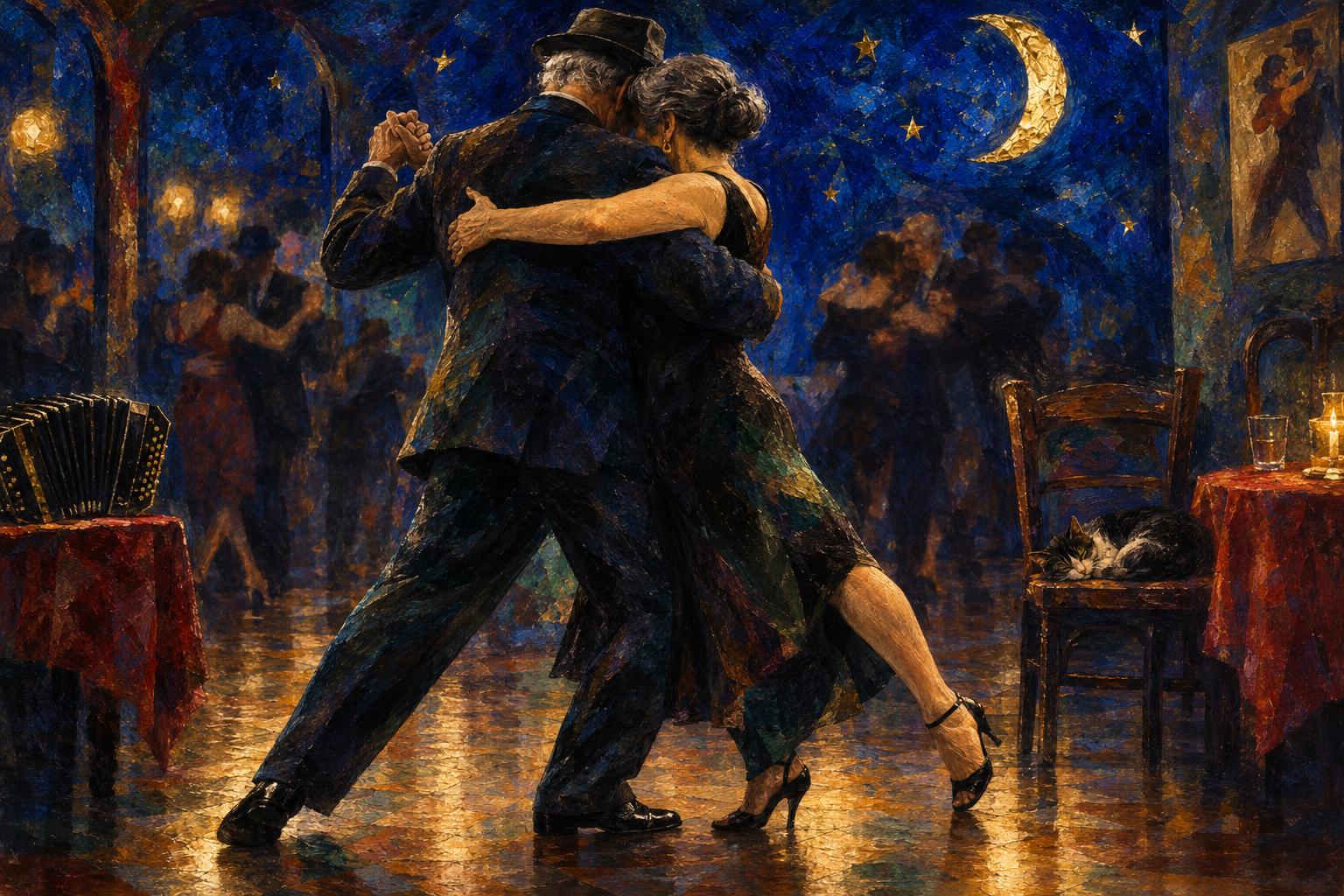
Visual created by Anita Flejter with the use of generative AI tools, inspired by the atmosphere and emotion of Argentine Tango.
What Good Embrace Feels Like
The best close embrace I ever danced was with a man in his seventies at a milonga in Buenos Aires. He said nothing. He did not smile. He simply opened his arms, I stepped in, and we both established our axes. His chest was a wall - not a hard wall, but a consistent one. I could feel every intention instantly because his frame never changed quality. When he wanted me to pivot, I felt it as a rotation in his ribcage. When he wanted me to step, I felt it as a shift in his weight. There was no ambiguity.
After the tanda, he nodded, I nodded back, and we parted. We had been as physically close as two strangers can be. We had exchanged no personal information. And yet I felt respected - because the embrace had been a tool, not a pretense. He had not tried to make it intimate. He had made it functional.
And because it was functional, it was safe. And because it was safe, it could be beautiful.
That is the irony. The close embrace only becomes emotionally meaningful when both partners treat it as emotionally neutral. The frame must be a frame. The transmission must be clean. The boundary must remain intact.
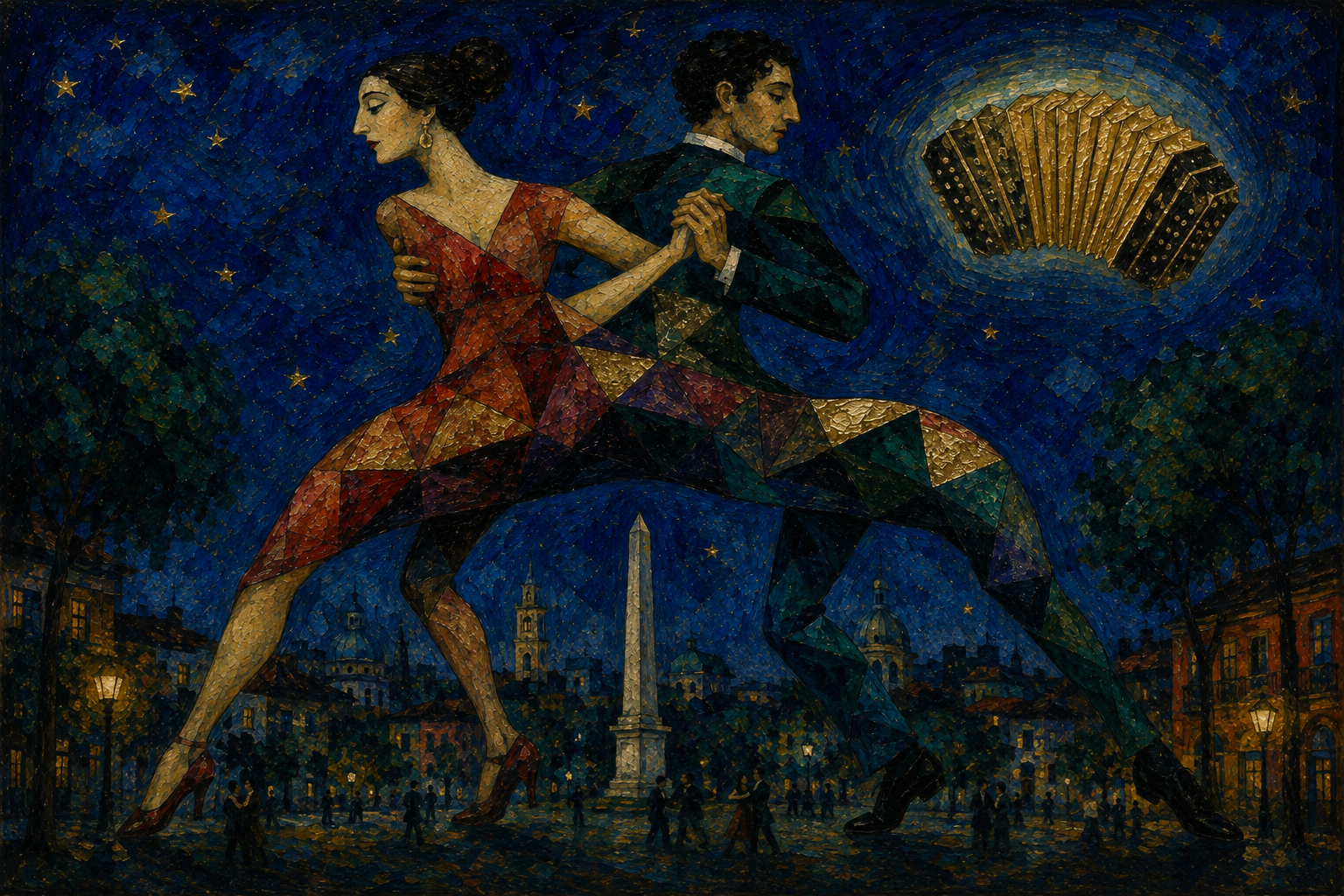
Visual created by Anita Flejter with the use of generative AI tools, inspired by the atmosphere and emotion of Argentine Tango.
What to Practice
If you want your close embrace to improve, stop trying to make it intimate. Start making it structural.
Maintain your own axis. Even in apilado, where you share weight, you must remain vertically stacked. Do not sag. Do not lean your head forward. Your center of gravity is yours to manage.
Keep your hands where they belong. The leader's right hand belongs on the follower's back, at or above the bottom of the shoulder blades. The follower's left hand belongs on the leader's shoulder or upper back. Wandering hands are not "expressive." They are violations.
Match your tone to your partner's. The embrace is a negotiation. If your partner offers light tone, do not crush them. If they offer firm tone, do not go limp. Listen with your body.
Release between songs. In traditional milonga etiquette, the embrace is released at the end of each song in a tanda. This is not cold. It is a reset. It reminds both partners that the physical proximity is bounded by the music.
Do not hide behind propriety. If you are so afraid of being creepy that you refuse to commit to the frame, you are not protecting your partner. You are abandoning them. Show up. Be present. Be correct.
Talk less. The close embrace is a channel for physical information. Filling it with verbal information - compliments, confessions, flirtation - clutters the channel and blurs the boundary.
The Payoff
When close embrace is done well, it produces a strange and wonderful effect: two people feel like one organism without either person losing themselves. This is not intimacy in the conventional sense. It is coordination at the highest level. The follower does not surrender; she participates. The leader does not control; he proposes. The embrace is the medium, not the message.
Mistaking the medium for the message is how milongas become uncomfortable. It is how beginners develop bad habits. It is how boundaries dissolve - or how fear of boundaries makes real connection impossible.
Close embrace is not intimate. It is close.
The difference matters.
Sources:
Lapin, Vladimir. (2016). *Tango and the Jewish Soul* [Thesis]. Hebrew Union College. <http://library.huc.edu/pdf/theses/Lapin_Vladimir-NY-MSM-2016%20rdf.pdf>
Manning, Erin. (2007). *Relationscapes: Movement, Art, Philosophy*. MIT Press. <https://mitpress.mit.edu/9780262633672/relationscapes/>
Merleau-Ponty, Maurice. (1962). *Phenomenology of Perception*. Routledge. <https://www.routledge.com/Phenomenology-of-Perception/Merleau-Ponty/p/book/9780415834339>
Baird, Haley. (2021). "An Ethnography of Contact Improvisation." MA Thesis, Concordia University. <https://spectrum.library.concordia.ca/988109/1/Baird_MA_S2021.pdf>
Larsson, Hanna Järlehed. "Polska Flirtation." *Ethnologia Scandinavica*. <https://escholarship.org/content/qt2v33h672/qt2v33h672.pdf>
Anteski, Ivica. "Dancing in Close Embrace." Tangomentor. <https://tangomentor.com/dancing-in-close-embrace/>
Laws, Kenneth. (2002). *Physics and the Art of Dance: Understanding the Moving Body*. Oxford University Press. <https://global.oup.com/academic/product/physics-and-the-art-of-dance-9780195341016>
Han, Byung-Chul. (2015). *The Transparency Society*. Stanford University Press. <https://www.sup.org/books/title/?id=25725>
"The Intimacy of Dancing Tango." Tango Voice. <https://tangovoice.wordpress.com/2019/07/24/the-intimacy-of-dancing-tango-therapy-for-contact-deprivation-in-north-american-society/>