Five Generations Hear Five Different Songs

Everyone on a milonga floor is dancing to the same recording. Almost nobody is hearing the same song. Here is why, and why that is the best thing about the room.
Here is an experiment you can run at any milonga. Wait for a Troilo tanda. Look around the floor. Every couple is dancing to the same recording, made in Buenos Aires in the early 1940s, played through the same speakers at the same volume.
Now look at who is dancing. A retired engineer who saw the Beatles on television. A woman who still owns her mixtapes. A product manager whose first music library came from Napster. A 23-year-old who discovered tango through a fifteen-second clip.
Same three minutes. Five different songs.
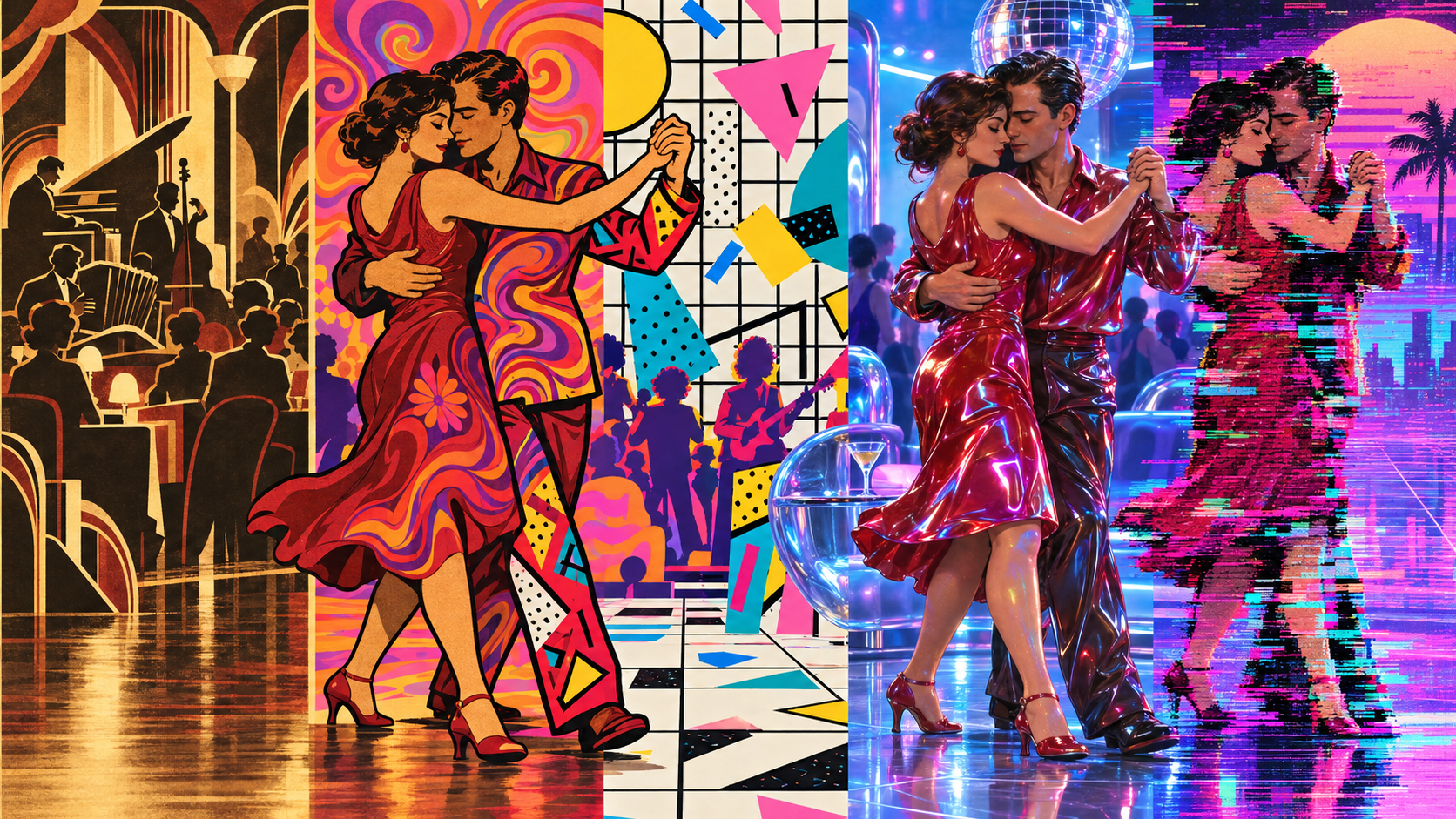
Visual by Anita Flejter, created with generative AI tools. Inspired by the atmosphere of Argentine tango and the art of five eras, from 1940s Art Deco to 2020s glitch art.
We usually talk about age in tango in terms of knees: who can still do a boleo, who dances until 2am and who leaves at 10. But the deeper difference between a 25-year-old and a 75-year-old on the same floor is not physical. It is musical citizenship. They grew up in different countries of sound, and they brought their passports with them.
Your ears were finished before you were
This part is not a metaphor. There is data.
In 2018 the economist Seth Stephens-Davidowitz got listening data from Spotify for every age group and looked at when people’s favorite songs were released. The pattern was strikingly consistent. For men, the songs that shaped adult taste most came out when they were between 13 and 16. For women, between 11 and 14. Music from our early twenties carried only about half that weight. (The New York Times)
In other words, your musical first language was set somewhere around eighth grade, by whatever was on the radio, in the car, or in your headphones. You did not choose it. Most of us were busy choosing a haircut we now regret.
It goes further back than that. At Cornell, the music psychologist Carol Krumhansl played college students hit songs from 1955 to 2009. As expected, they responded most to the music of their own youth. But they also showed a clear bump for the music of the early 1980s, when their parents were young adults, and a smaller one for the 1960s, their grandparents’ era. Krumhansl called it a “cascading reminiscence bump.” (Cornell Chronicle) Your ears carry your parents’ records, and sometimes your grandparents’.
So when you walk into a tango class, you are not bringing one ear. You are bringing a family archive.
The five passports
Here is a rough map of who is on our floor in 2026, and where their ears were formed. The generation labels are blunt instruments, so treat them as neighborhoods, not cages.
The orchestra ear (over 80). Formed in the 1940s and 50s: big bands, live radio, singers standing in front of a dozen musicians who breathed together. This ear hears texture. The band is not backing the singer; the band is the argument, and the singer is one voice in it. The beat is not a grid. It is a pulse that swells and recedes, the way a heart actually beats. In Buenos Aires, this generation did not learn tango as a heritage art. It was simply the music, the way pop is simply the music now.
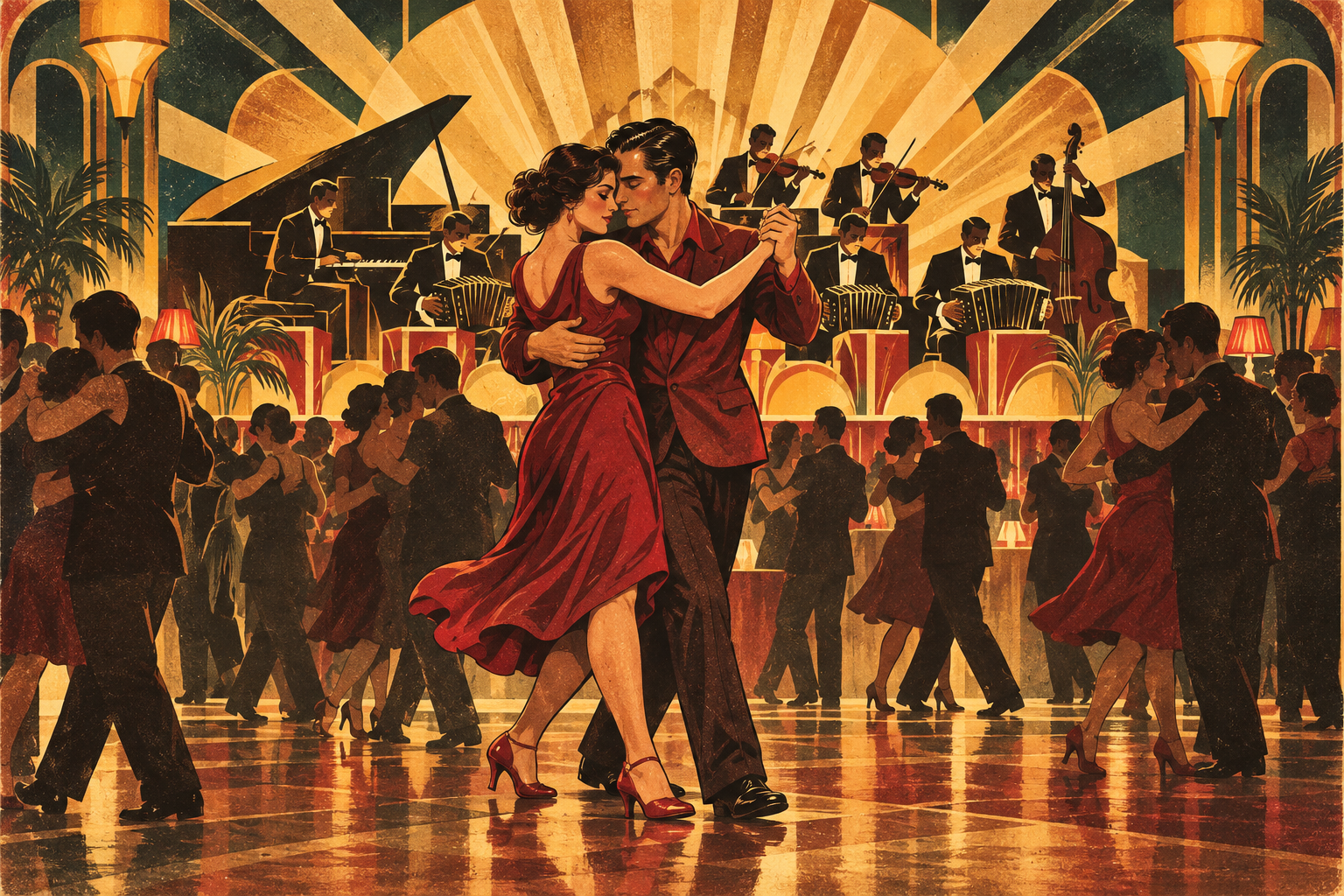
Visual by Anita Flejter, created with generative AI tools. Inspired by the atmosphere of Argentine tango and 1940s Art Deco dance hall posters.
The song ear (Boomers, roughly 62 to 80). Formed in the 60s and 70s: the Beatles, Motown, Dylan, the album you played front to back with the lyrics printed on the sleeve. This ear listens for the story. It finds the singer first and follows the words, even when the words are in a language it does not speak. It also learned, at a very impressionable age, to clap on two and four. Hold that thought.
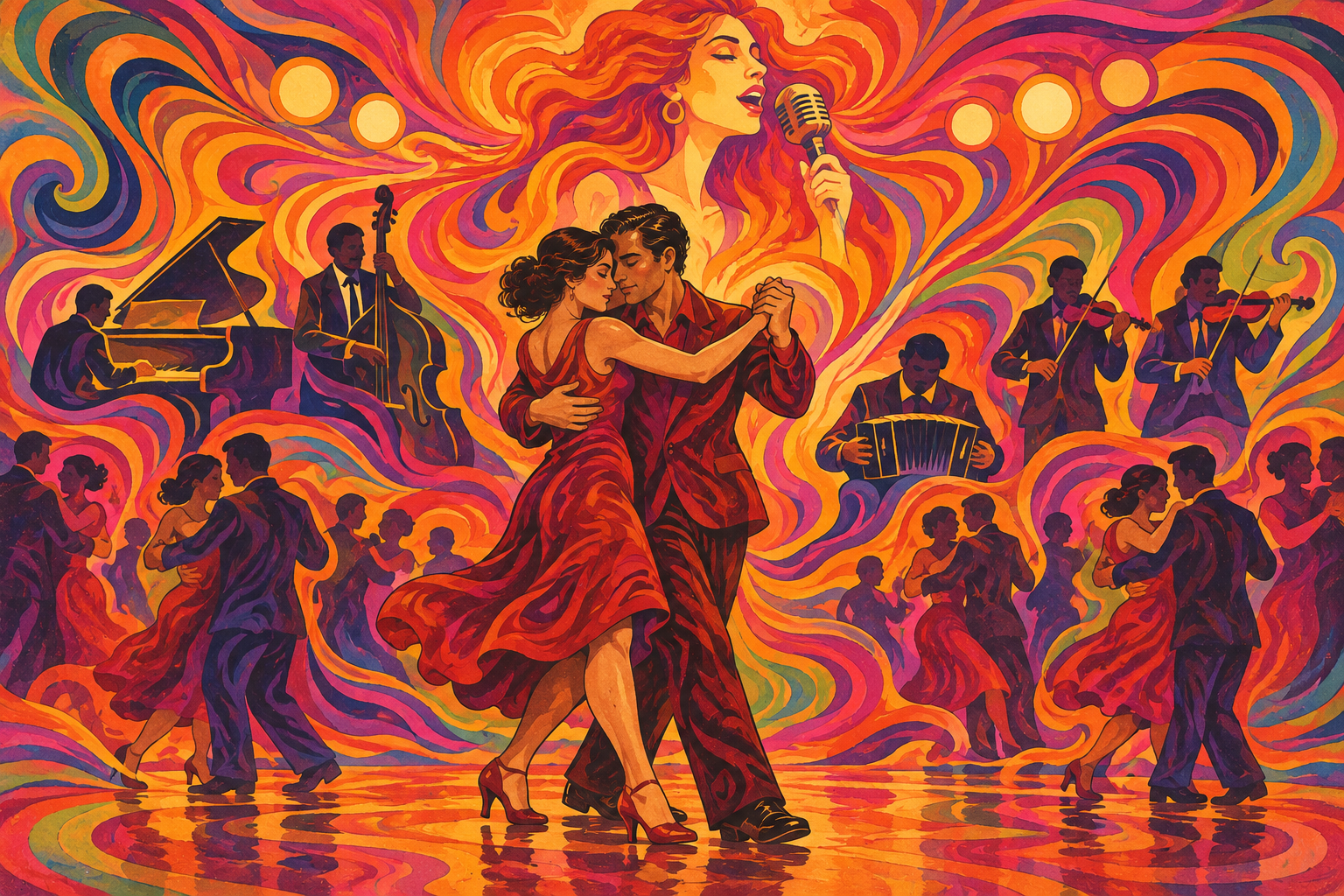
Visual by Anita Flejter, created with generative AI tools. Inspired by the atmosphere of Argentine tango and 1960s psychedelic concert posters.
The mixtape ear (Gen X, roughly 46 to 61). Formed in the late 70s through the mid 90s: punk, disco, MTV, hip-hop, grunge, and a Walkman. This was the generation of genre tribes, and of the mixtape: a carefully sequenced set of songs, built for one specific person, with a mood that had to hold from start to finish. Which means Gen X understood the tanda decades before they took their first class. They invented it. They just called it “Side A,” and the cortina was the tape hiss.
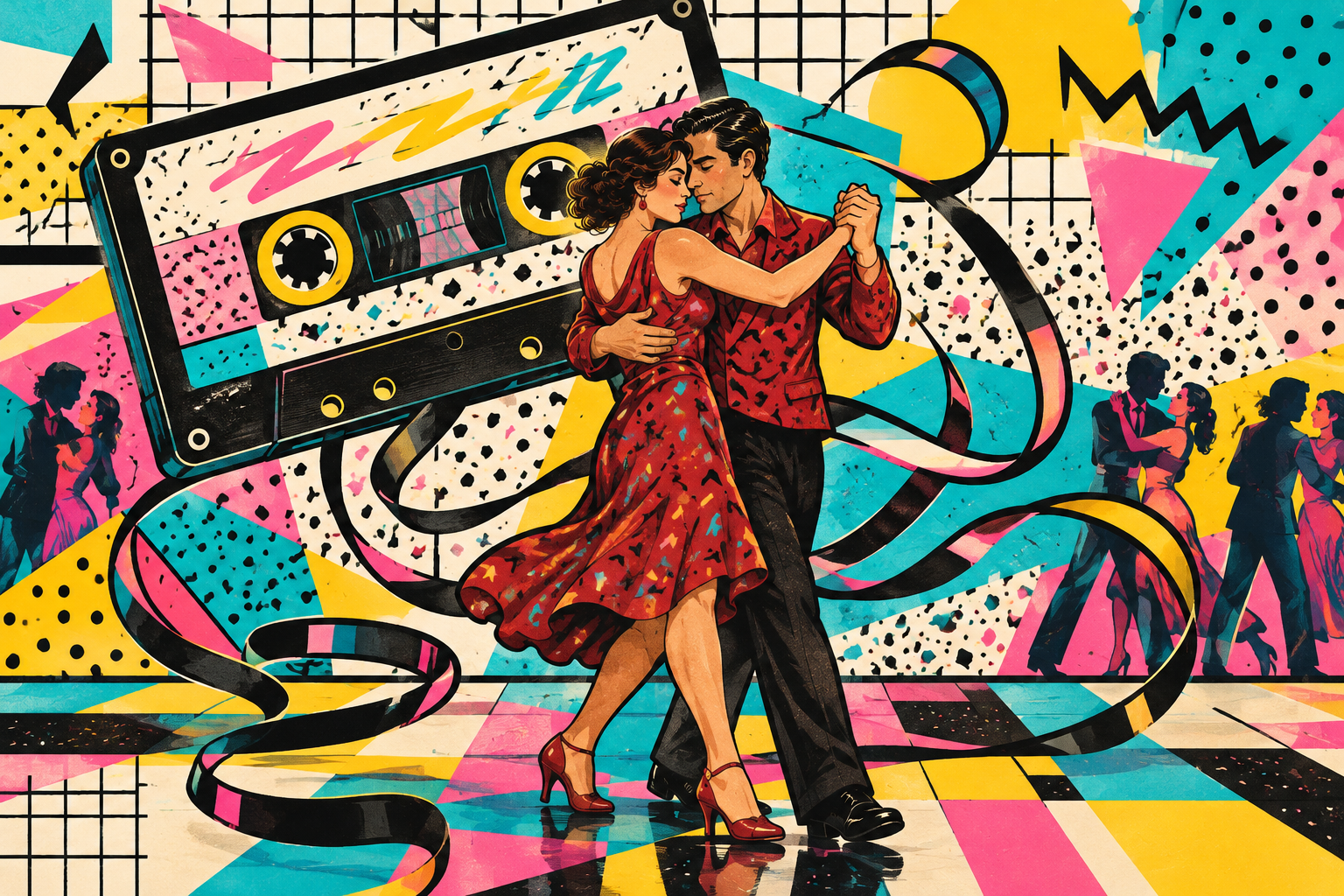
Visual by Anita Flejter, created with generative AI tools. Inspired by the atmosphere of Argentine tango and 1980s Memphis design.
The shuffle ear (Millennials, roughly 30 to 45). Formed in the late 90s and 2000s: the CD, Napster, the iPod, shuffle, YouTube. The first generation to carry a thousand songs in a pocket, and to hear them in random order. This ear is bilingual. Many millennials grew up on their Boomer parents’ records before building their own libraries, so they can hear the orchestra as texture and the beat as an engine, often without choosing. Their adolescence happened at exactly the moment popular music fractured into a hundred genres at once, and they learned that different songs ask for different kinds of listening.
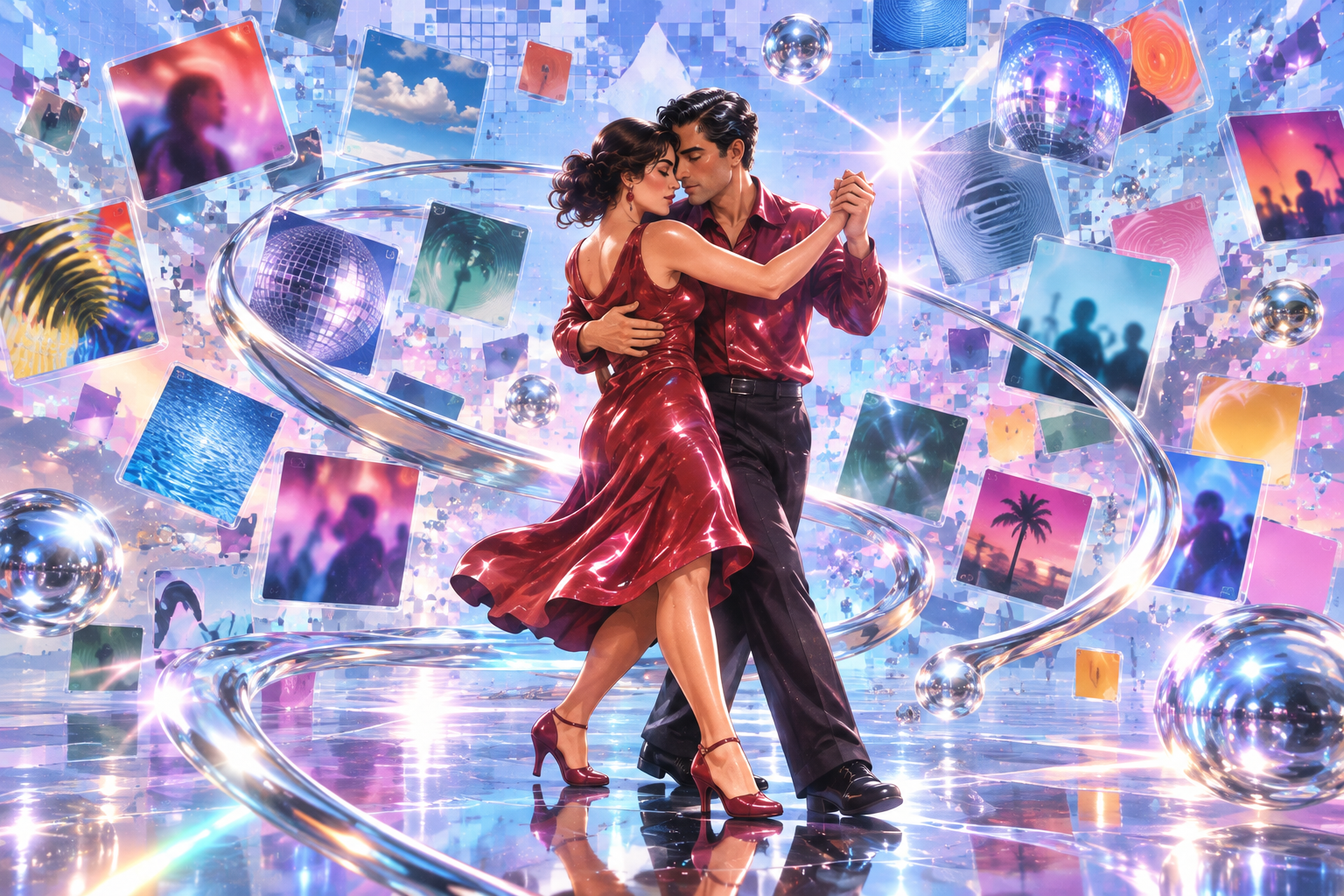
Visual by Anita Flejter, created with generative AI tools. Inspired by the atmosphere of Argentine tango and Y2K and early internet design.
The fragment ear (Gen Z, under 30). Formed by streaming and TikTok. This ear grew up inside the attention economy, and the music changed to fit it. A study at Ohio State found that the instrumental intros of top-10 hits shrank from about 20 seconds in the mid-1980s to about five seconds by 2015, because, as the researcher put it, “there’s always another song.” (Ohio State News) Spotify’s own data found that roughly a quarter of all plays are skipped in the first five seconds, and that teenagers skip the most. (Spin) Songs got shorter, hooks moved to the front, and on TikTok whole hits now go viral in sped-up versions. (InsideHook)
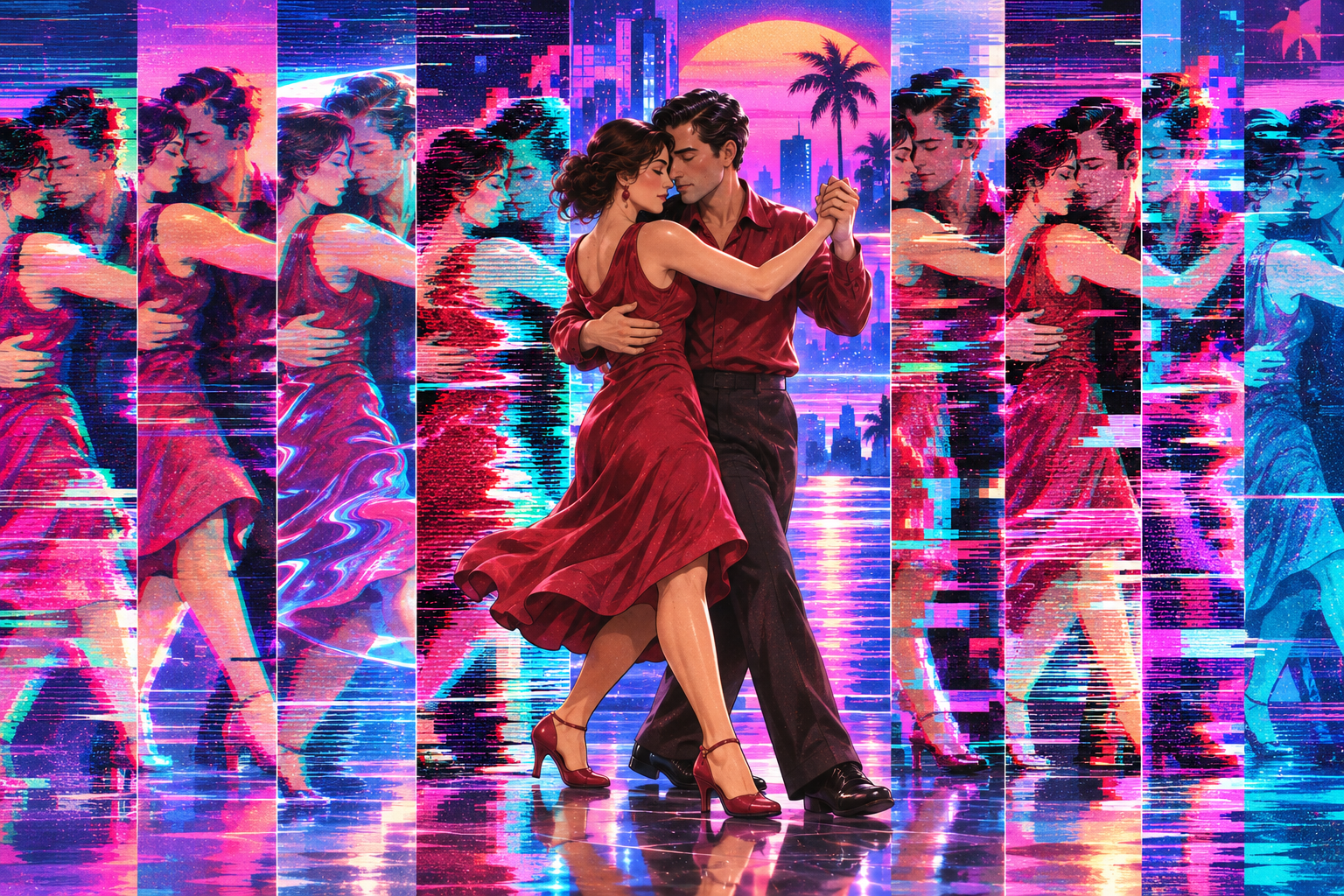
Visual by Anita Flejter, created with generative AI tools. Inspired by the atmosphere of Argentine tango and 2020s glitch art and vaporwave.
That sounds like a diagnosis. It is not. It is a superpower with a known side effect. The fragment ear hears contrast instantly. Switch from Pugliese to D’Arienzo and it does not blink, because switching is all it has ever done. It has no orchestra loyalty and no rule that a certain sound belongs to a certain mood. It judges each song on what the song is doing right now.
And here is the good news nobody tells our youngest dancers: tango was TikTok length before TikTok. Golden age recordings run about three minutes, because that is roughly what one side of a 78 rpm record could hold. You are not learning an old, long art form. You are learning the original short form.
A note on our 23-year-olds
It is worth separating the under-30s from everyone else, and not only because of TikTok.
When the streaming service Deezer surveyed listeners in 2018, the peak age for discovering new music came out at about 24: that is when most respondents were listening to ten or more new tracks a week. By around 30, many people had settled into what Deezer called “musical paralysis,” replaying what they already loved. (Music Business Worldwide) It is a marketing survey, not a laboratory study, so hold it lightly. But it matches what we see in class.
Our 23- and 24-year-olds are arriving at tango at the most open moment their ears will ever have. They will absorb Di Sarli the way the rest of us absorbed whatever was playing at our first school dance. Some of them will hear D’Arienzo once and never recover. We know, because it has happened before.
Tango has been answering the radio for ninety years
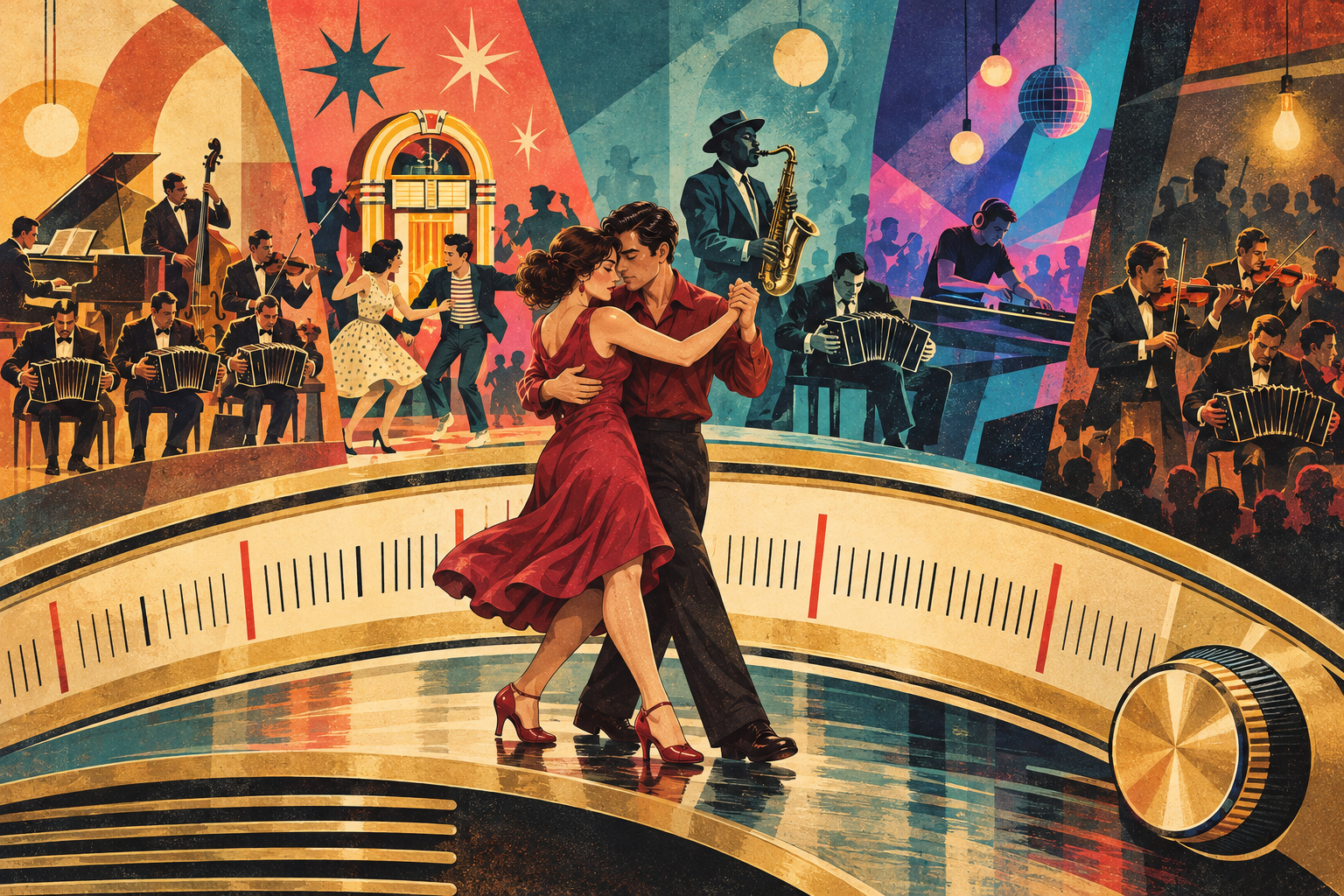
Visual by Anita Flejter, created with generative AI tools. Inspired by the atmosphere of Argentine tango and 1950s mid-century illustration.
None of this is new to tango. Every time popular music changed the way a generation listened, tango either lost that generation or found a way to talk to it.
1935: rhythm wins the young back. By the early 1930s much of tango had drifted toward music for listening, and dancers had drifted away. Then Juan D’Arienzo, with the pianist Rodolfo Biagi, brought back a sharp, driving beat. Within months the dance halls filled again, and D’Arienzo knew exactly who he had won. “Young people like me,” he said. (Tangology 101) That is the first fragment ear in tango history: rhythm first, details later.
1955: rock and roll takes them away. Tango historians generally close the golden age around 1955, the year rock and roll went global. (Wikipedia: New Guard) In Buenos Aires, record labels shifted from tango to rock, and young people began treating tango as music for their parents. (Leiden University) Political repression made it worse. So, Boomers in our classes: the music of your youth is, historically speaking, the music that emptied the milongas. Welcome home. No hard feelings.
1974: tango sits down with jazz. Astor Piazzolla recorded Summit (Reunión Cumbre) in Milan with the American baritone saxophonist Gerry Mulligan, a conversation between two musical citizenships on one record. (Wikipedia: Summit)
2001: tango plugs in. Gotan Project released La Revancha del Tango, tango laid over electronic beats, and it found an audience far outside the milonga. Bajofondo, Narcotango, Tanghetto and others followed, and the style got a name: electrotango. (La Nación) A remarkable number of today’s forty-somethings first heard a bandoneón in a lounge, a film, or a car commercial, thanks to this wave.
2001, again: tango gets loud. The same year, in the middle of Argentina’s economic collapse, a group of young musicians formed the Orquesta Típica Fernández Fierro. Classic typical-orchestra lineup, Pugliese as the model, and an attitude closer to a punk band: they release their own records and run their own club. (Buenos Aires Tourism) Their own description: “The most rock in Tango’s History and the most Tango in Rock’s History.” (WOMEX)
2006 and 2008: new orchestras for dancers. Sexteto Milonguero (founded 2006 by Javier Di Ciriaco) and the Orquesta Típica Misteriosa Buenos Aires (founded 2008) took a different route: young musicians playing golden age format tango, built for the dance floor, with today’s energy. (Gasteig München) These are the orchestras that play live for today’s mixed-age floors, which means they are, quite literally, writing for five passports at once.
So the conversation between tango and the radio never stopped. It just changed who was holding the microphone.
What each ear hears, and what it misses
Here is where I want to be careful, because this can slide into “old good, young bad” very quickly, and that is lazy. Every ear hears something the others miss.
The orchestra ear hears texture: the bandoneóns breathing in unison, the violins underneath like weather, the last chorus played louder because the band is leaning into it. What it can miss is the freshness of a rhythm it has heard a thousand times.
The song ear hears story. It knows the singer is the point, and in tango the words carry so much. What it often misses is the beat tango actually walks on.
A quick bit of music theory. Most popular music runs in bars of four beats, counted one, two, three, four. In rock, R&B and pop, the drummer hits the bass drum on one and three and the snare drum, that loud crack, on two and four. That snare is the backbeat, and it is where a crowd claps without being told. Think of “We Will Rock You”: stomp, stomp, clap. The clap is the backbeat.
Tango has no snare drum. It puts its weight on one and three, and that is where the walk lands. But an ear raised on the Beatles and Motown keeps hearing an invisible snare on two and four. We often see students spend their first months dancing, very confidently, to a drummer who is not in the orchestra.
The mixtape ear hears architecture: sequence, mood, the arc of a set. It understands tandas and cortinas instinctively. What it sometimes misses is sincerity. Gen X often arrives at tango a little ironically, and then stays completely sincerely. We have seen it many times.
The shuffle ear hears range. It moves between styles easily and enjoys the canon and the experiments equally. What it can miss is depth, because when everything ever recorded is one tap away, it is hard to stay with one orchestra long enough to really know it. (Six months with Di Sarli will change your life. Six minutes will not.)
The fragment ear hears contrast and honesty. What it often misses is patience: the long arc of a three-minute song as one journey rather than a sequence of moments. Music that takes forty-five seconds to say something can feel broken to an ear trained on five-second verdicts. To a 23-year-old, a long Pugliese pause can sound like the song is buffering. It is not buffering. That is the song. (More on why in The Music Makes You Wait.)
And even the founders of the conversation could not agree. The composer Enrique Santos Discépolo famously defined tango as “a sad thought that is danced.” Jorge Luis Borges thought the line sounded like it came from someone who had never heard a tango, and insisted the older tango-milonga was “a happy and brave music.” (Letralia) Two of Argentina’s great writers, hearing two different songs. We are in good company.
What this means if you teach, or learn
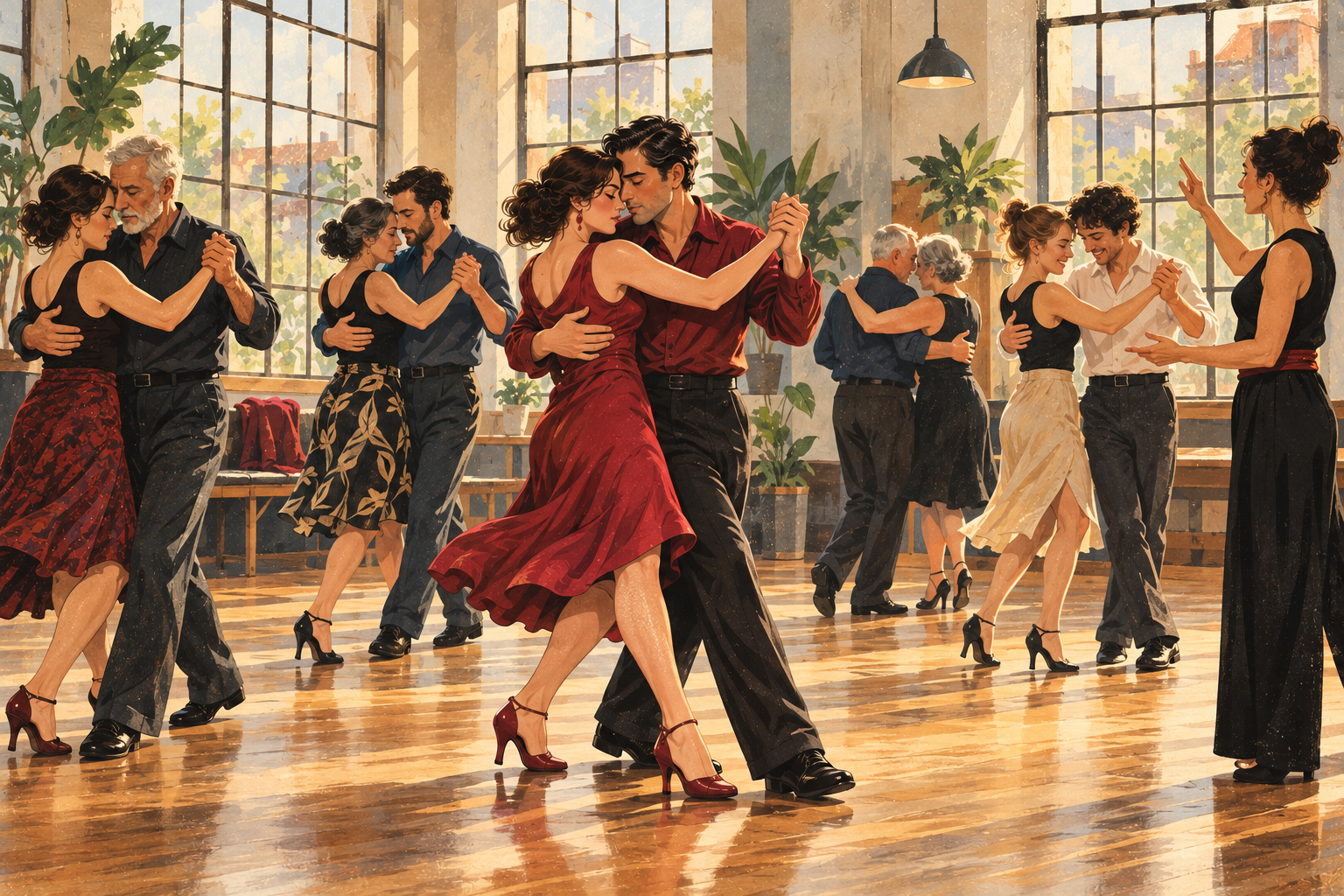
Visual by Anita Flejter, created with generative AI tools. Inspired by the atmosphere of Argentine tango and contemporary editorial illustration.
If you teach tango, this changes your job. You cannot teach “musicality” as one thing, because there is no neutral ear. When you tell a room to “listen to the melody,” the song ear already is, the mixtape ear is checking how this track fits the set, and the fragment ear is waiting for the drop. The same sentence lands as five different instructions.
So you translate:
• To the song ear: let go of the backbeat. Walk on one and three, and let the singer carry you between them.
• To the orchestra ear: you already hear everything. Now pick one instrument per song and dance only to it.
• To the mixtape ear: you know how to build a set. Now dance the arc of the tanda, not just the song in front of you.
• To the shuffle ear: stop sampling. Pick one orchestra and live with it for a month.
• To the fragment ear: this song is not a feed. It is one sentence, the period is at the end, and you cannot understand any word until you hear the whole thing.
And if you are a student: before you decide that a certain orchestra “doesn’t speak to you,” it is worth asking whose ears you brought to it. You did not choose your musical first language. But you can learn a second one. That is why you are in a tango class and not at a lecture about tango. Fluency is available to everyone. It just does not arrive through the same door for everyone.
A listening prescription for every ear
One track that meets you where you are, and one that stretches you.
• Fragment ear. Start with D’Arienzo’s Nueve de Julio, from Biagi’s very first session with the orchestra in 1935: pure drive, no waiting. Then stretch with Troilo and Fiorentino’s Toda mi vida and stay for the whole sentence.
• Shuffle ear. Start with Gotan Project’s Santa María (del Buen Ayre). Then stretch with Di Sarli’s Bahía Blanca and notice how much is happening in how little.
• Mixtape ear. Start with Fernández Fierro’s Infierno porteño, loud. Then stretch with Troilo and Fiorentino, and let yourself be sincere about it.
• Song ear. Start with Troilo and Fiorentino, where the singer is the story. Then stretch with Pugliese’s La Yumba and find the beat with no voice to lead you.
• Orchestra ear. Start with Di Sarli. Then stretch with today’s orchestras: Sexteto Milonguero’s Pocas palabras or Misteriosa Buenos Aires’s San Pugliese, and hear the same tradition in younger hands.
• For everyone: Piazzolla and Mulligan’s 20 Years Ago, two traditions hearing each other in real time.
One tanda, two passports
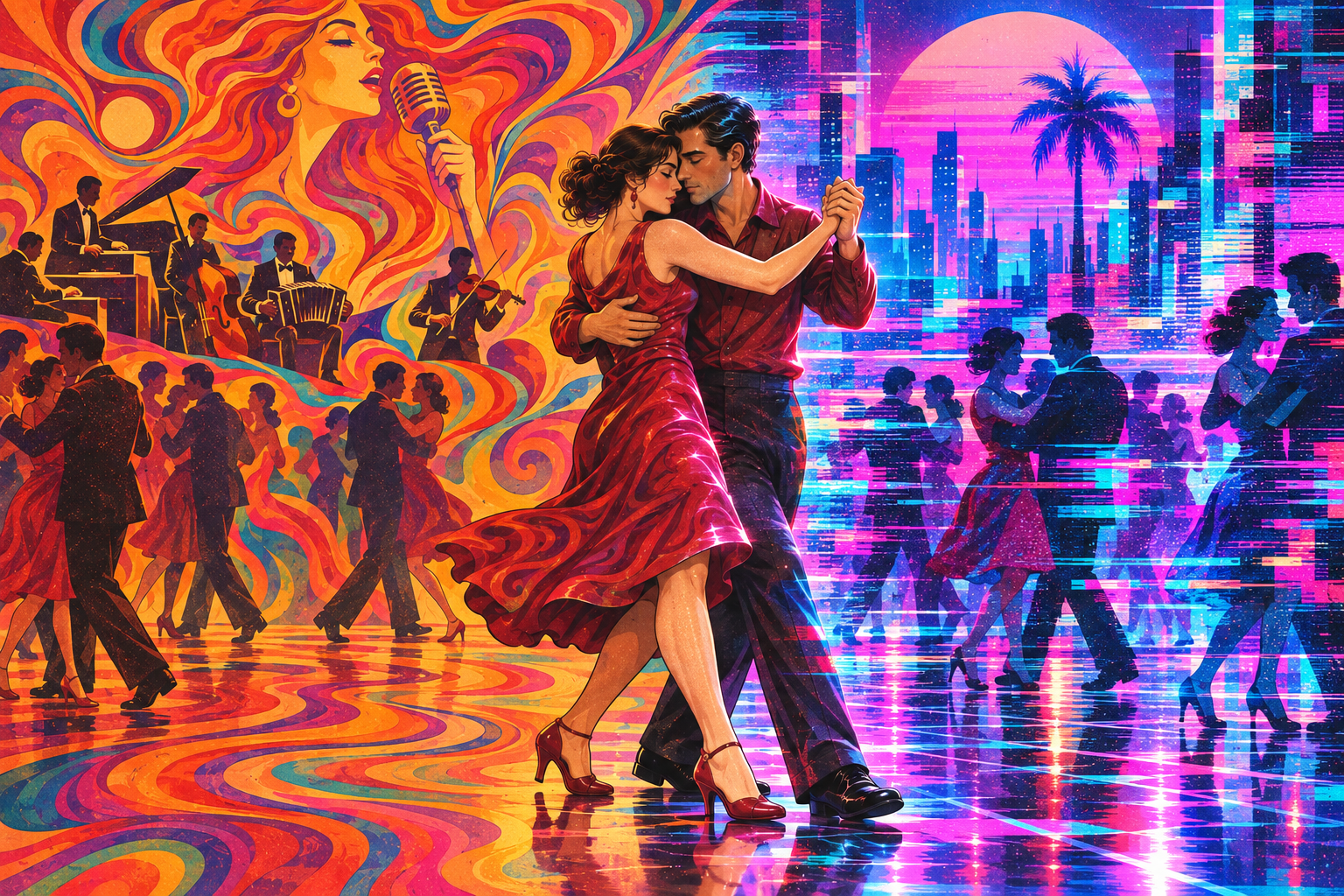
Visual by Anita Flejter, created with generative AI tools. Inspired by the atmosphere of Argentine tango and 1960s psychedelic posters and 2020s glitch art.
Last Saturday I watched a Boomer and a Gen Z dancer share a Troilo tanda. He is 71: thirteen years old when the White Album came out. She is 24, which makes her a teenager the year TikTok went global.
I would bet almost anything they were not dancing to the same song. He was following Fiorentino’s voice, the lyric, the ache, the way the Beatles taught him to listen for the story. She was riding the rhythm section, the walking bass, the crisp piano, because her ears were formed by two decades of music that puts the beat up front. Neither of them was wrong. They were both right, in different dialects.
What made it work was the embrace. The embrace is not only a physical frame. It is a negotiation between two people’s listening. For twelve minutes, two musical citizenships had to find common ground in real time, with no words, at walking speed. Sometimes his patience pulled her deeper into a phrase. Sometimes her clarity pulled him back onto the beat. Back and forth, a bar at a time.
And notice one more thing. On Spotify, roughly every other song gets skipped before it ends. (Spin) At a milonga, nobody skips. You commit to twelve minutes with one person on the strength of a look across the room, and you stay until the cortina, whether the song is your first language or not.
The milonga is one of the last rooms in modern culture where five generations show up and do the same thing together. Not watch it. Do it, physically, in contact. The oldest dancers teach the youngest how to wait. The youngest teach the oldest how to hear rhythm freshly, how to be surprised by a Biagi syncopation at 70. Nobody announces it, nobody plans it, and the exchange runs in both directions every single night.
Five generations walk into every milonga. They hear five different songs. And then, one tanda at a time, they agree to dance to the same one.
Your generation gave you your ears. The milonga gives you everyone else’s.
Sources:
• Stephens-Davidowitz, S. (2018). The Songs That Bind. The New York Times
• Krumhansl, C. L. and Zupnick, J. A. (2013). Cascading Reminiscence Bumps in Popular Music. Psychological Science 24(10). Summary: Cornell Chronicle
• Léveillé Gauvin, H. (2017). Drawing listener attention in popular music. Musicae Scientiae. Summary: Ohio State News
• Lamere, P. (2014). The Skip. Summary: Spin
• Deezer survey (2018). Music Business Worldwide
• Sped-up songs on TikTok: InsideHook
• D’Arienzo and the 1935 revival: Tangology 101, Todo Tango
• End of the golden age and rock and roll: Wikipedia: New Guard (tango), Leiden University thesis, Atlas Obscura
• Piazzolla and Mulligan: Wikipedia: Summit
• Electrotango: La Nación
• Fernández Fierro: Buenos Aires Tourism, WOMEX
• Misteriosa Buenos Aires: Gasteig München
• Discépolo and Borges: Letralia