Why Milonga Rhythm Is Not Just "Fast Tango"

The first time you try milonga, your feet will lie to you. They will tell you that the solution is to move faster. Take the tango walk, squeeze it into half the time, and you are done. This is the most natural mistake in the dance, and it is the one that keeps beginners stuck for months.
Milonga is not fast tango. It is a different language with a different grammar, and until you hear that difference, you will be translating in real time and always running behind.
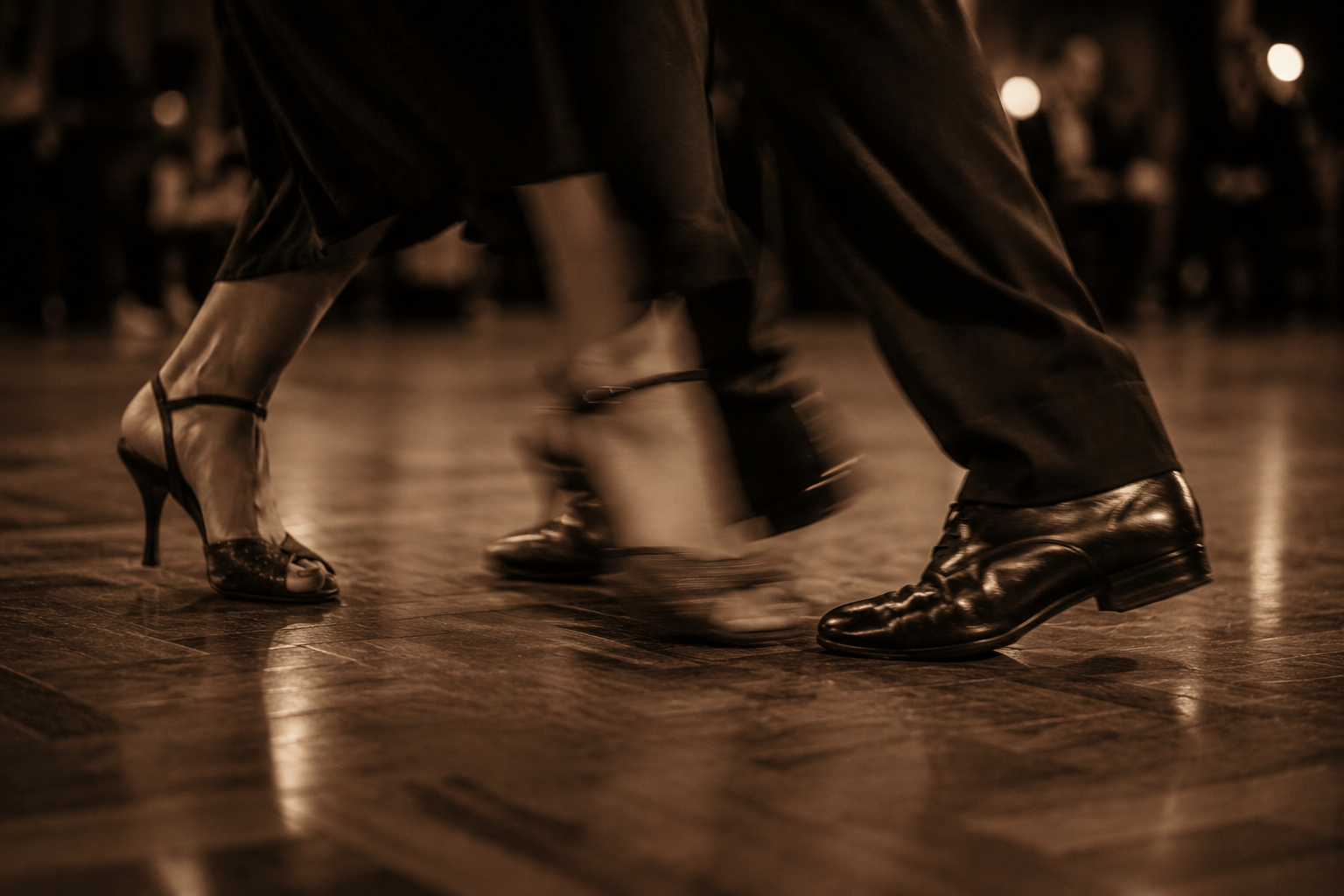
Visual created by Anita Flejter with the use of generative AI tools, inspired by the atmosphere and emotion of Argentine Tango.
The Cadencia Is the Real Difference
At Ultimate Tango, we teach that milonga cadencia is fundamentally different from tango. In tango, you arrive on the beat. You project, land, and settle. The music breathes around you.
In milonga, you do the opposite: you leave from the beat. You push off earlier, and the beat catches you as you arrive.
That shift in timing is what creates the illusion of hopping, bouncing, or walking with the vibe. It is not that your feet are doing more. It is that your relationship to the pulse has flipped.
This is why milonga is, paradoxically, closer to a normal walk than tango is. In a normal walk, you do not plan each landing. You push off, fall slightly, and the ground meets you. In tango, you learn to change that expectation: you arrive with intention, you land with control, you inhabit the beat. Milonga asks you to unlearn that. You have to change your perspective, leave earlier, and let the beat slide under you rather than meeting it head-on.
You can see it before you can feel it. Watch a milonguero cross the floor to a Canaro milonga and the giveaway is how little happens at the ankles. There is no reaching, no pointing, no visible effort in the feet. The movement lives in the center, and the feet simply arrive underneath - light, early, already leaving for the next step before the beat lands. That lightness is not decoration. It is the timing made visible.
If you try to arrive on the beat in milonga, you will feel perpetually late. The music will seem to speed up and slow down unpredictably. The truth is that the music is steady. You are simply stepping at the wrong point in the cycle.
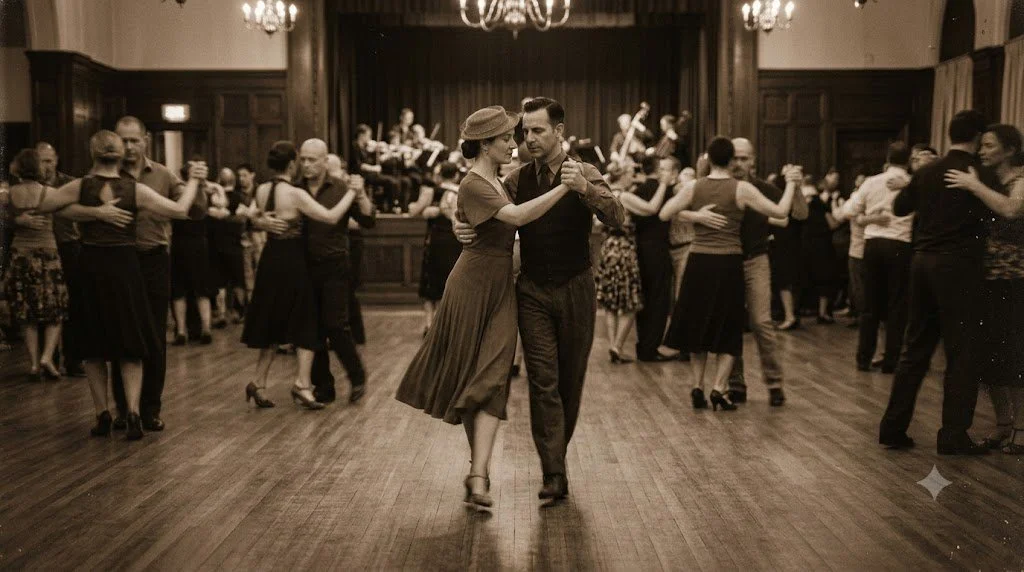
Visual created by Anita Flejter with the use of generative AI tools, inspired by the atmosphere and emotion of Argentine Tango.
The Rhythmic Pattern: 1–4–5–7–1 Is a Cycle, Not a Line
Milonga music has a distinctive, repetitive rhythmic structure that tango simply does not share. As we teach in our Milonga Intensive, the underlying pattern is counted as 1 – – 4, 5 – 7. You will sometimes hear it counted 1 – – 4, 1 – 3 instead - that is the same rhythm, just restarted from the halfway point so each half counts up from one. Do not let the two versions confuse you: they describe the same accents. Count it as 1 – – 4, 5 – 7 and you will not go wrong. The critical thing to understand is that this is a cycle: you have to hear it from 1 back to 1. The accents fall on 1, 4, 5, and 7 - and the two halves of that cycle are not equal.
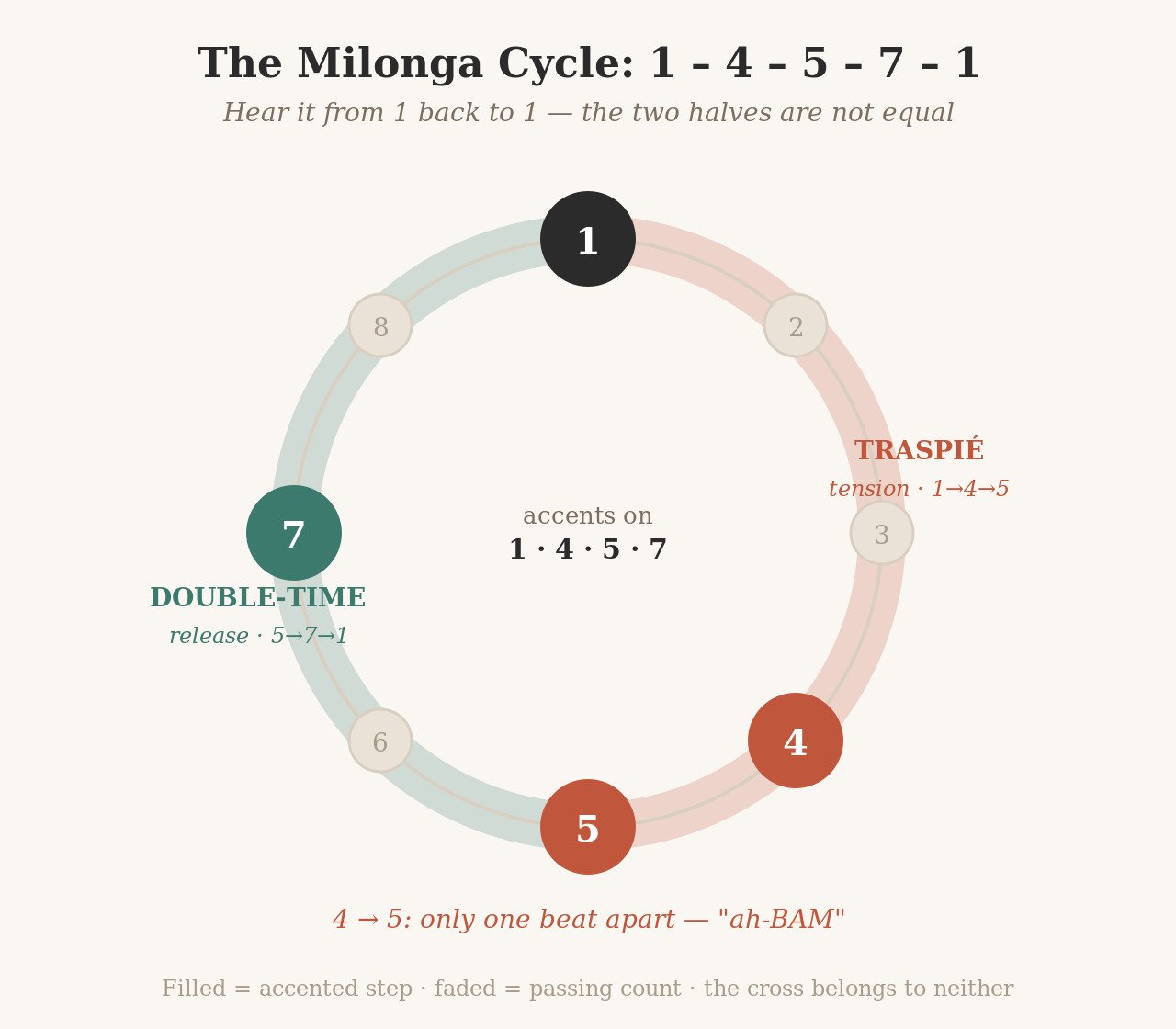
The critical thing to understand is that this is a cycle: you have to hear it from 1 back to 1. The accents fall on 1, 4, 5, and 7 - and the two halves of that cycle are not equal.
The first half, from 1 through 4 to 5, carries the syncopated pulse that calls for traspié. The 4 and 5 are only one beat apart. That compression - the way the music rushes from the 4 into the 5 - is what creates the characteristic "ah-BAM" rhythm. As the instructors at Learn to Dance Tango clarify: "Some people think traspié as double-time, but I think of it as sort of, 'Ah-bam!'" The difference matters. Double-time is stepping on every beat. Traspié is a syncopated displacement - a small, sharp weight shift that happens inside the beat rather than on top of it. Because it is so fast, the movement has to be tiny: as you get faster, you get smaller.
The second half of the cycle, from 5 through 7 back to 1, drives forward with a more even pulse that calls for double-time. The spacing here is different: 5 to 7 is two beats, 7 to 1 is one beat. The music loses that compressed syncopation and pushes straight ahead. Where the first half stutters, the second half rolls. If you try to traspié through this half, you will be fighting the momentum. If you try to double-time through the first half, you will miss the syncopation entirely. The two halves work as call and response: the traspié creates rhythmic tension, and the double-time releases it into forward motion.
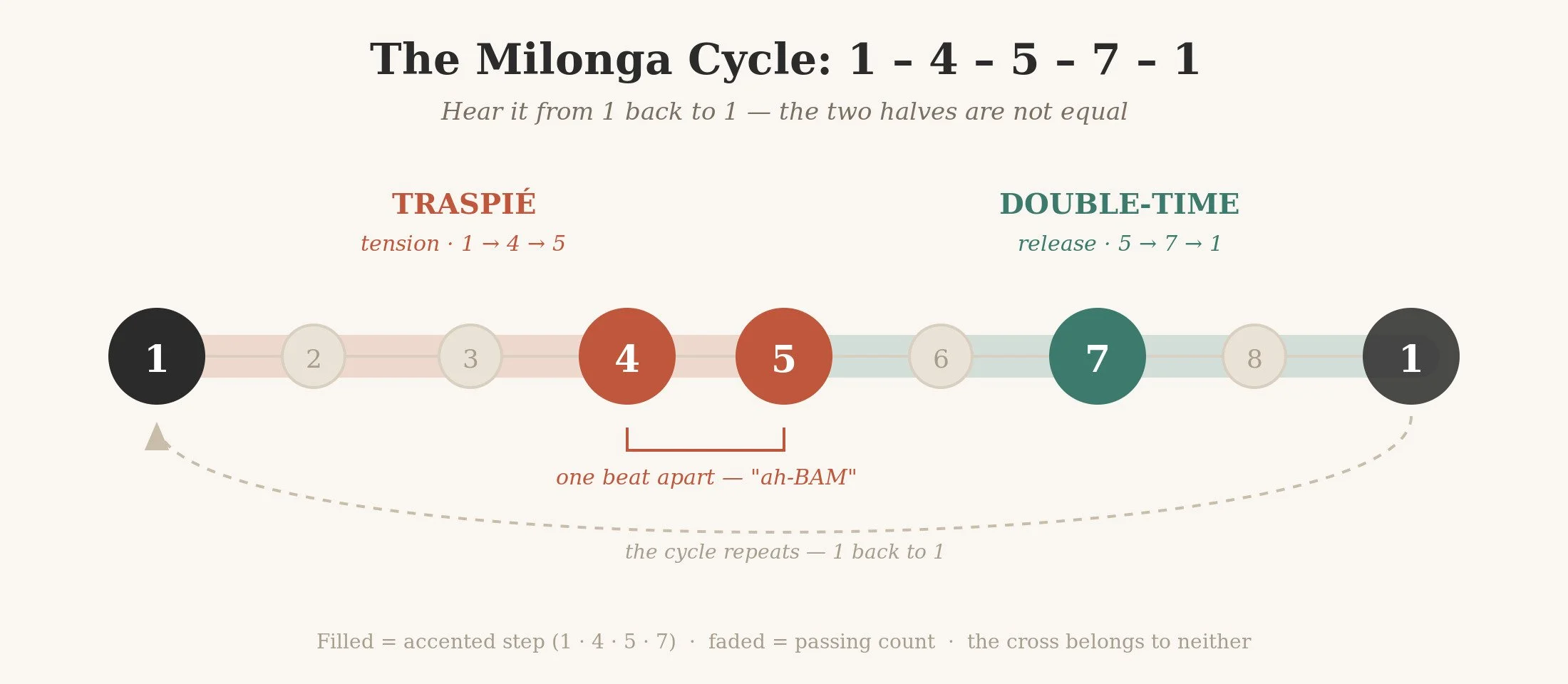
The two halves work as call and response: the traspié creates rhythmic tension, and the double-time releases it into forward motion.
Why the Cross Does Not Belong Here
If you learned tango in the standard way, you probably started with the basic to the cross: the salida, the cruzada, the eight-count box that forms the foundation of most tango vocabulary. In milonga, that same sequence will feel like you are dragging a suitcase through a revolving door.
The cross is a tango convention. It breaks the walk, creates a moment of suspension, and then resolves.
In tango, that suspension is beautiful. In milonga, it is a mistake.
Milonga is built on continuity. The rhythm does not pause for your cruzada. The beat keeps moving, and if you stop to cross, you have to rush to catch up.
This is why experienced teachers will joke that old milongueros turn in their graves when they see a cross in milonga.
It is not about tradition for tradition's sake. It is about the fact that the cross - as a structural event - does not fit the music. Milonga is rhythmic walking, not rhythmic stopping-and-starting. The vocabulary that works is different: rebounds, small ochos, changes of direction, the baldosa, the corrida. These keep the feet moving and the center in motion. The cross does the opposite.
That does not mean you can never have a crossed position in milonga. It means that the basic to the cross, the eight-count sequence you learned in one of your first tango classes, is not the organizing principle. In milonga, the walk itself is the organizing principle. Everything else is a variation on that walk, not an interruption of it.
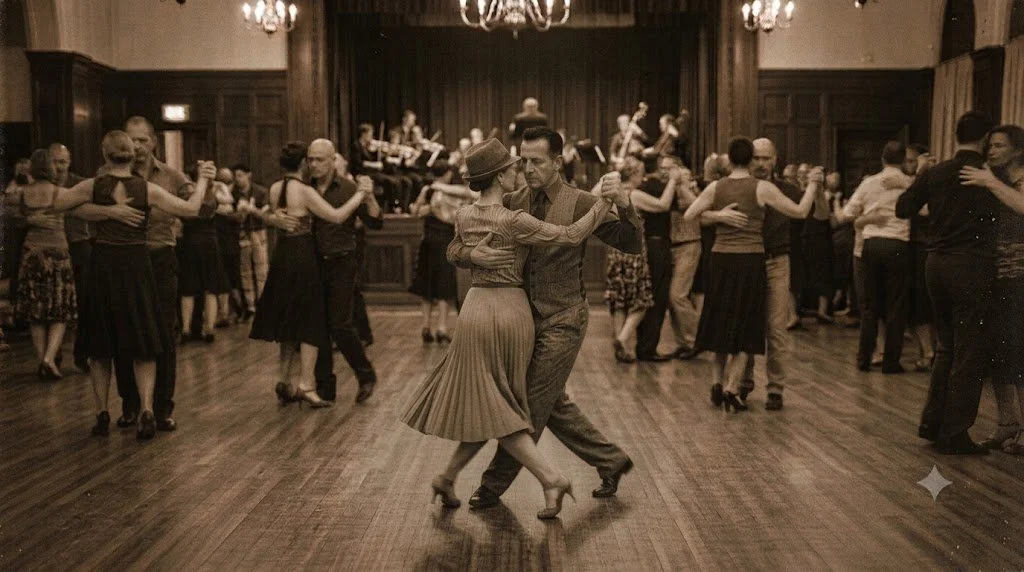
Visual created by Anita Flejter with the use of generative AI tools, inspired by the atmosphere and emotion of Argentine Tango.
What to Actually Practice
If you want milonga to feel natural, you have to practice the rhythm in your body before you worry about steps. Here is where to start:
Walk on the beat, then leave from it. Practice walking to a steady pulse, but consciously push off a fraction earlier than you think you should. Feel the difference between arriving on the beat and arriving after leaving from it. The second version should feel lighter, almost bouncy.
Drill the two halves separately. Listen for the 1–4–5–7 pattern in a Canaro milonga. In the first half, try traspié: small, sharp weight displacements that stay underneath your center. In the second half, try double-time: clean, even steps on each beat. Do not mix them until each half feels natural on its own.
Get smaller as you get faster. The instinct is to reach with the foot or point the toe to stay on the rhythm. As the Learn to Dance Tango instructors emphasize, "Really what you want is a small movement of the center which drives the foot or weight change. Small so you have time and the center so it's real." If your feet are doing the work, you are too big. If your center is doing the work, you can be fast without being frantic.
Ditch the cross for a while. Spend an entire practice session dancing milonga without a single cruzada. Use walks, rebounds, changes of direction, and small ochos. Notice how much simpler the musical choices become when you are not trying to fit a tango figure into a milonga slot.
Listen to Canaro and D'Arienzo side by side. Canaro's milongas are lighter, more melodic, easier to find the playfulness. D'Arienzo's are driving, almost percussive. Your body will respond differently to each. The rhythm is the same on paper. The feel is not.
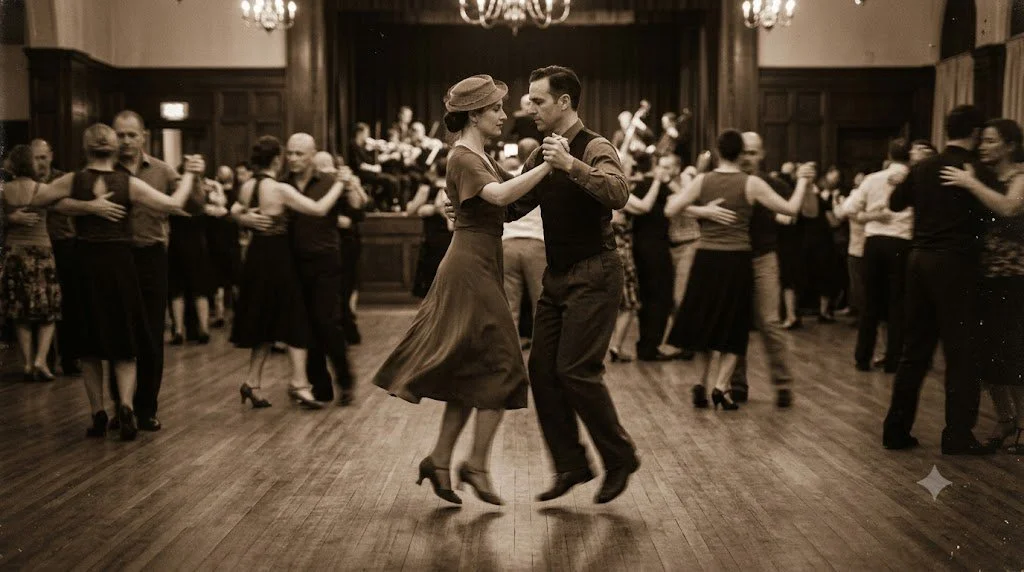
Visual created by Anita Flejter with the use of generative AI tools, inspired by the atmosphere and emotion of Argentine Tango.
The Payoff
When milonga clicks, it does not feel rushed. It feels buoyant. The floor is driving, the couples are moving in a tighter current, and instead of working harder, you are working cleaner. The steps that felt frantic at first start to feel effortless, not because you got faster but because you stopped fighting the music.
At Ultimate Tango, we teach Milonga as its own module because it is.
The cadencia, the rhythmic structure, the vocabulary, and the floorcraft are distinct enough that trying to fold them into an advanced tango class does them a disservice. If you have been avoiding milonga because it feels like a workout, you are probably dancing fast tango. Come learn the actual language. The music has been waiting for you to catch up.